
On this page · 6 sections
The address amazon.com turns 32 this Sunday.
It was registered on Tuesday, Nov 1, 1994, about five weeks after relentless.com and six weeks after awake.com and browse.com. Jeff Bezos and his wife, MacKenzie, were hunting for a name for an online bookstore that didn't exist yet, and they were collecting web addresses the way some people collect stamps.
| Address | Registered |
|---|---|
| awake.com | Sept 20, 1994 |
| browse.com | Sept 20, 1994 |
| relentless.com | Sept 25, 1994 |
| bookmall.com | Oct 24, 1994 |
| amazon.com | Nov 1, 1994 |
Registration dates for .com addresses are public records, which means anyone with a web browser can find out when a given address was first registered and when its current registration runs out, including every one in this table. Amazon came last in the line. The others show how it got there.
A magician's word
The company's first name was Cadabra. On July 5, 1994, Bezos filed the paperwork for Cadabra, Inc. in Washington state, a shortened "abracadabra." It was supposed to suggest a little magic.
His lawyer, Todd Tarbert, wasn't charmed. The reference was obscure, and over the phone "Cadabra" kept getting heard as "cadaver." A bookstore that wants strangers to type in a credit card number can't afford a name that sounds like a morgue.
So the hunt went on. Awake and browse were plain enough, and bookmall described exactly what it did. Then there was Relentless, which the couple also liked. Friends told Bezos it sounded a bit sinister.
Relentless lost, but he kept the address. Type relentless.com into a browser today and you land on amazon.com. We checked this morning.
Aardvark to zebra
In October 1994, Bezos tried something simple. He opened a dictionary to the A section, because website listings were alphabetized back then and a name near the top of the alphabet would come up first. He found Amazon, and he knew why it fit. "This is not only the largest river in the world, it's many times larger than the next biggest river," he explained. "It blows all other rivers away."
He then walked into the garage that served as the company's makeshift office and told his colleagues the new name. By the account of Brad Stone, who wrote the best-known book on the company, Bezos gave the impression that he didn't care to hear anyone's opinion on it.
Weeks later, on Nov 1, the address was registered.
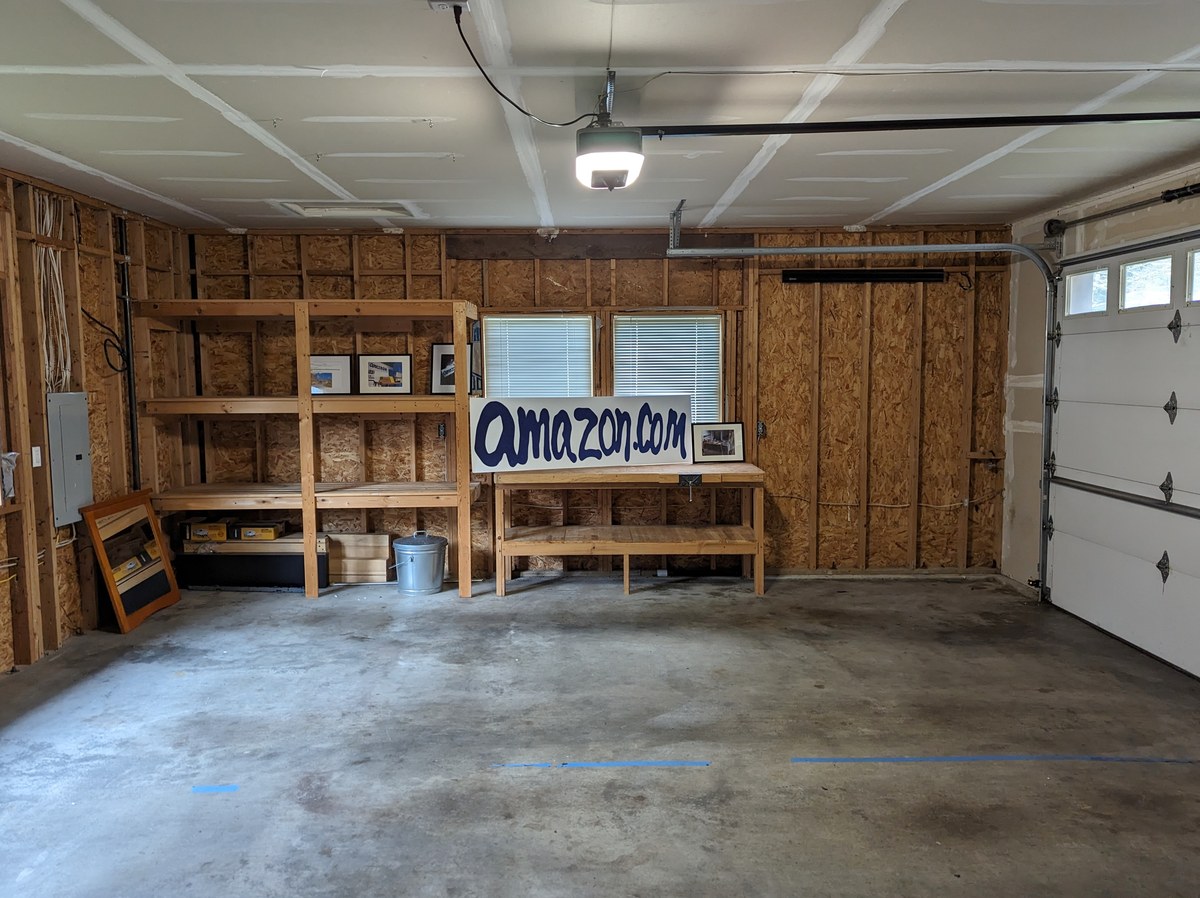 The garage of the Bellevue, Washington, house where Amazon started, photographed at a January 2024 open house while the home was for sale. Photo: SounderBruce, CC BY-SA 4.0, via Wikimedia Commons.
What the name was worth
Three years later, the river had a lot of water in it. In its 1997 letter to shareholders, Amazon reported that it had served more than 1.5 million customers, up from 180,000 a year earlier, that sales had jumped 838 percent to $147.8 million, and that more than 58 percent of orders in the last quarter came from people who had bought before. Music was next, planned for 1998.
The website's audience grew as fast as the sales. Measured by the research firm Media Metrix, it climbed from 90th place among web sites to within the top 20. The partner list reads like a roll call of the 1997 web: America Online, Yahoo!, Excite, Netscape, GeoCities, AltaVista, @Home and Prodigy. Three years earlier, the company had been a few people in a garage and a name that took six weeks to settle.
In the letter's first paragraph, Bezos wrote a line people still quote: "But this is Day 1 for the Internet and, if we execute well, for Amazon.com." The shareholders also saw the brand listed as a measure of success, right beside customer and revenue growth.
One more detail is easy to miss. A few pages in, under the principles the company pledged to follow, the first line reads, "We will continue to focus relentlessly on our customers."
The word survived after all.
The address itself is quiet now. The public record shows amazon.com registered on Nov 1, 1994, paid up through Oct 31, 2027, and locked against deletion, transfer and changes.
Why a company keeps a name it no longer uses
Relentless is a small example of something plenty of big brands do. Companies buy addresses they have no plan to use and point them back home. relentless.com still points to Amazon, 32 years after the name was passed over, and many other brands do the same with common misspellings, so that a typo still lands in the right place.
Scammers work the other direction. They register the lookalikes nobody bothered to buy: an extra letter, a zero in place of an O, a hyphen, a different ending such as .shop. A shopper who types fast, or taps a link in a text message, rarely notices the difference.
That's where the birthday on file helps. A copycat can borrow a logo, a color scheme and a slogan in an afternoon, but it can't easily fake a registration date.
What it means for you
Every shop you visit online has an address with a birthday on file. You can read it, and the birthday tells you something.
A site that claims to be a longtime favorite but was registered last month deserves a pause. Scammers set up fake stores, delivery notices and "account locked" pages, often on brand-new addresses, because the real company's address is already taken.
To check, go to lookup.icann.org and type in the address, leaving off the https:// and anything after the .com (or .org, .net or whatever it ends in). Find the date the address was first registered. Amazon's reads 1994. A fake "Amazon deals" site usually won't.
A new address doesn't make a shop fake. Plenty of honest small businesses open every week. What matters is whether the date fits the story. A store that advertises "serving customers since 1998" on an address registered in September is telling you something, and so is a "clearance sale" from a company that has only existed for a month.
Age isn't proof either. Old addresses can be sold, and a thief can take one over. Treat a recent date as a warning and an old date as one good sign among several.
The address bar deserves a second look too. Read the address up to the first single slash, then look at the last two chunks before it (a few countries use three, such as .co.uk). In amazon.com/deals, the shop is amazon.com. In amazon.com.deals-today.shop/offer, the shop is deals-today.shop, and the "amazon.com" at the front is decoration. Swapped letters work the same way. Amaz0n.com with a zero is a different site.
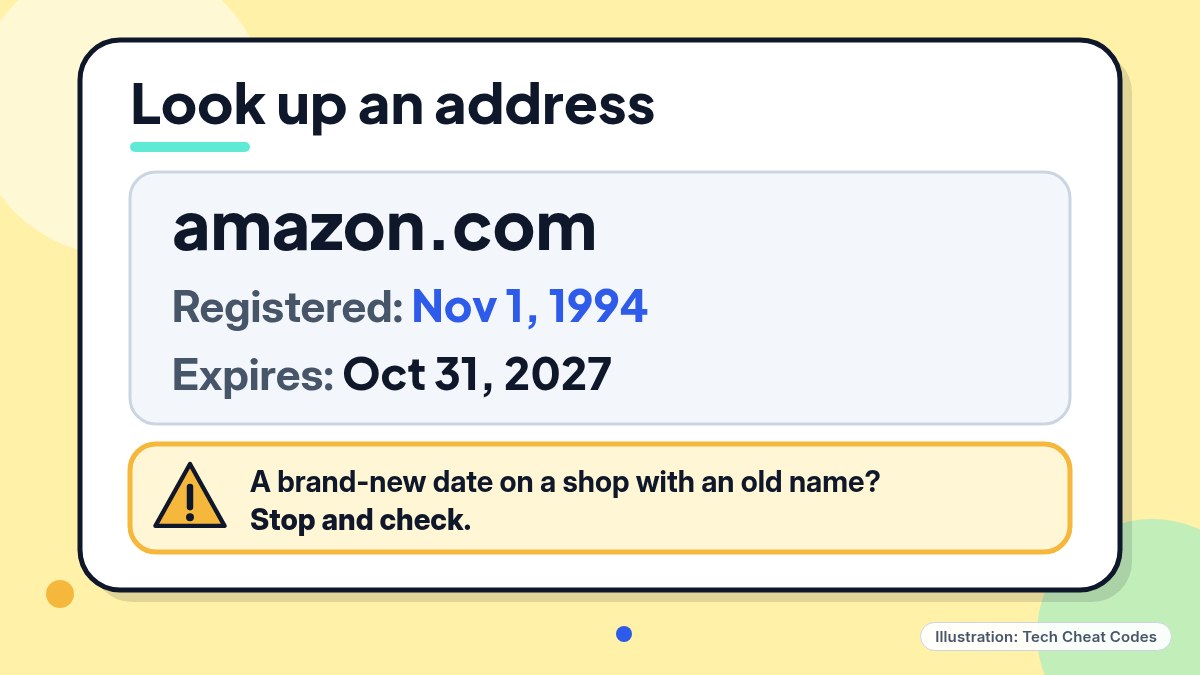 Illustration: Tech Cheat Codes.
One case comes up constantly. A text arrives saying a package couldn't be delivered, with a link to confirm your address. Whether it names Amazon, the post office or a delivery company, the safe move is the same: don't tap it. Open the shop's own app, or type its address yourself, and look for the order there. If the order isn't there, the message wasn't about you.
If you do want to look at a link you didn't expect, spend two minutes at lookup.icann.org first, and keep your card number to yourself until the date makes sense. A parent or grandparent who shops online will get more use out of that routine than out of any antivirus pop-up.
References
- Source: Verisign RDAP public records for amazon.com, relentless.com, awake.com, browse.com and bookmall.com, checked Oct 31, 2026
- Source: CNBC, "Amazon CEO Jeff Bezos' secrets to success," Jul 5, 2019 (Cadabra, Relentless, the dictionary search and the river quote)
- Source: The Christian Science Monitor, "The Everything Store: 5 behind-the-scenes stories about Amazon" (the name candidates)
- Source: Business Insider, how Jeff Bezos chose the company name, May 2018
- Source: Amazon.com 1997 letter to shareholders
- Source: ICANN Lookup, the free registration-date lookup tool