
On this page · 5 sections
Nineteen years ago today, Google answered months of Gphone rumors with a flat no. Then it launched the open phone software that would put a computer in billions of pockets.
On Monday, Nov 5, 2007, the company posted a short note under a cheeky title — "Where's my Gphone?" — and joined 33 other firms in a new group called the Open Handset Alliance. The product was not a single Google-branded handset. It was Android: an operating system, interface and apps stack meant to run on phones other companies would build. Partners talked about shipping those phones in the second half of 2008. Shoppers who wanted something to hold that day got nothing but a blog post and a promise.
Today is Thursday, Nov 5, 2026. That announcement turns 19.
Not a phone. A platform with 34 names on it
By late 2007, the rumor mill had a name ready. Gphone. Google Phone. One device, one brand, one splashy unboxing. Apple had already put the iPhone on sale that June. Bloggers and cable shows treated Google's next move like a matching set.
Google's mobile chief, Andy Rubin, opened the day's post by shutting that story down. Despite months of speculation, the company was not announcing a Gphone. What it was announcing — the Open Handset Alliance and Android — was, in his words, more significant and ambitious than a single phone. Google Chairman and CEO Eric Schmidt put the same idea in the alliance press release: the day was more ambitious than any single "Google Phone," and the platform was meant to power thousands of different phone models.
The alliance listed 34 founding members. Carriers such as T-Mobile, Sprint Nextel, NTT DoCoMo, China Mobile, Telefónica and Telecom Italia sat next to handset makers HTC, Motorola, Samsung and LG. Chip and component firms filled the rest of the roll — Qualcomm, Intel, Broadcom, Texas Instruments, Nvidia, SiRF and others — along with software and services names including eBay and Nuance. The pitch was blunt for 2007: mobile software had been a closed stack of carrier deals and proprietary OS licenses. Android would ship as a full stack under a progressive open-source license, so makers could customize it and developers could reach the hardware without begging for keys.
An early software development kit was promised within about a week. Actual phones, the alliance said, should show up in the second half of 2008. No store shelves. No price. No color options. Just a software foundation and a coalition.
Google had bought the small Palo Alto startup behind the name — Android Inc. — in 2005. Co-founders Andy Rubin, Rich Miner, Nick Sears and Chris White had been building the platform since around 2003. Rubin had earlier helped create the Danger Hiptop, better known to T-Mobile customers as the Sidekick. Inside Google, the Android team kept working while the outside world still mostly knew Google as a search and ads company that happened to put Maps and Gmail on other people's phones.
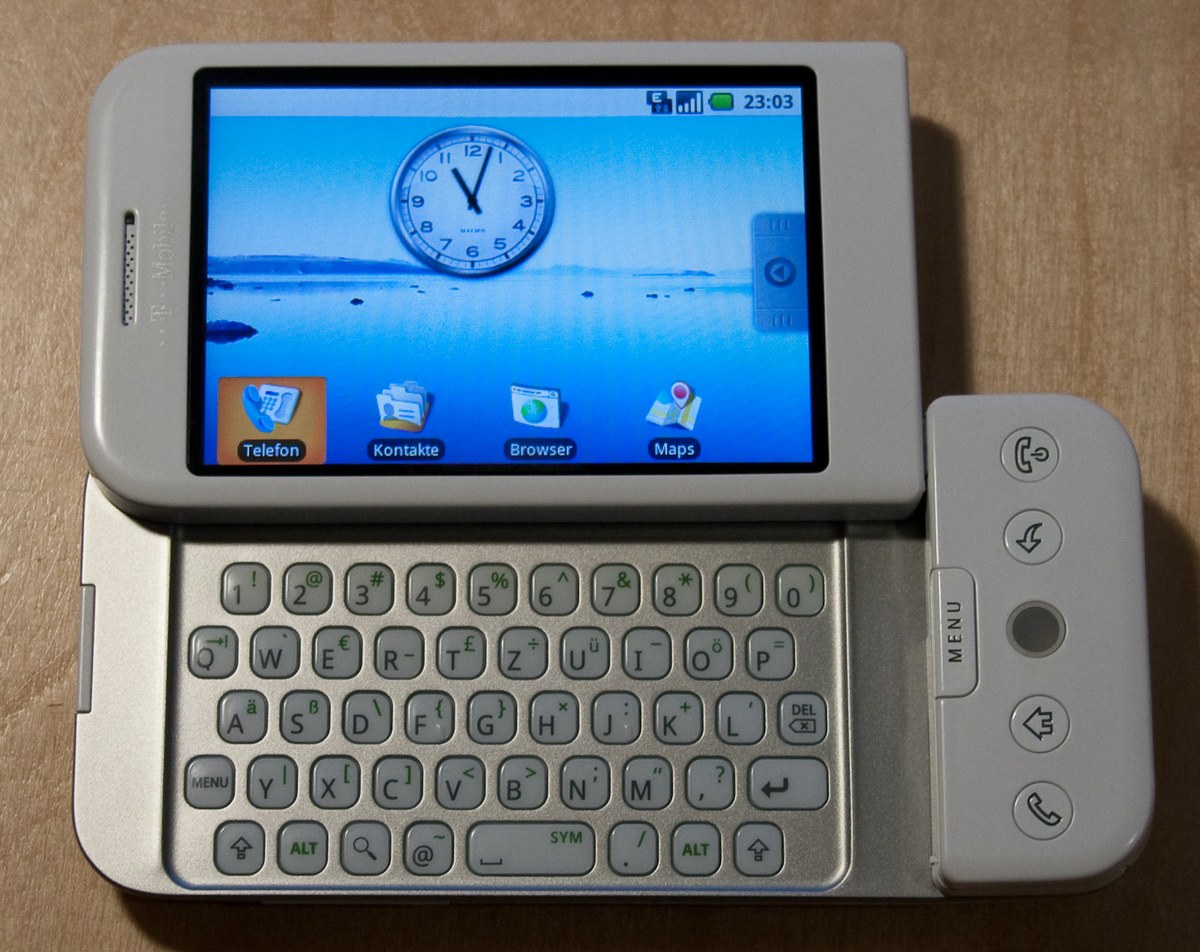 A white T-Mobile G1 (HTC Dream) with the screen slid open over its physical keyboard — the first phone that finally put Android in someone's hand. Photo: Marcus Sümnick, CC BY 3.0, via Wikimedia Commons.
Almost a year of waiting, then a sliding keyboard
If you lived through those months, the wait felt long. Tech blogs refreshed for months on "Gphone" sightings that were really platform demos and partner whispers. The first commercial Android phone did not arrive until fall 2008.
On Sept 23, 2008, T-Mobile, Google and HTC unveiled the T-Mobile G1, also known as the HTC Dream. U.S. stores and the T-Mobile site started selling it on Oct 22 for $179 with a two-year voice and data agreement. The hardware looks quaint now: a 3.2-inch touchscreen that slid aside on a hinge to show a full QWERTY keyboard, a clickable trackball for one-handed poking, and early Google apps such as Gmail, Maps with Street View and YouTube baked in. It was also the first phone to open Android Market, the early app store.
That G1 did not "beat" the iPhone in a headline duel. It did something quieter. It proved Google's Nov 5 claim in plastic and glass: one open platform, built by partners, sold under a carrier brand, with no Google logo stamped on the front as the main event. HTC built it. T-Mobile sold it. Android ran underneath. More models followed from more factories. The "thousands of different phone models" line stopped sounding like press-release fog.
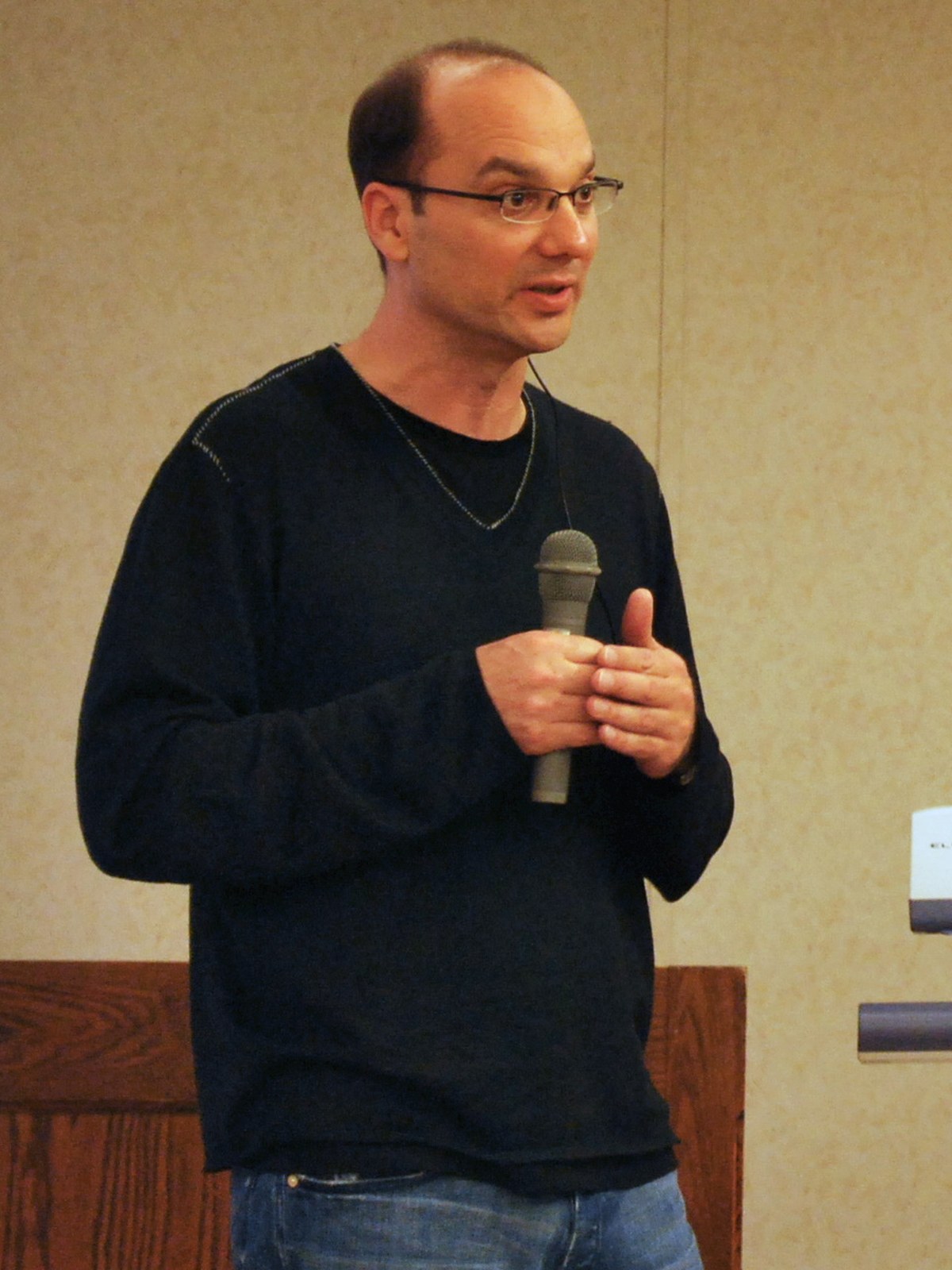 Andy Rubin speaking at Google Developer Day in Japan in June 2008 — months after the Android announcement and months before the first phone went on sale. Photo: Yoichiro Akiyama, CC BY-SA 2.0, via Wikimedia Commons.
What it means for you
If your phone runs Android today, that Nov 5, 2007 stack is the ancestor of the software under your thumb. Security patches still come from Google and from your phone maker, on a schedule your maker sets. App installs still flow through a store that grew out of that first Android Market. The open-platform bet also means your next phone can come from Samsung, Google, Motorola or a dozen other labels and still feel familiar enough that your photos, chats and passwords can move over.
It also means the boring safety settings matter more, not less. Scam texts and fake "package" links are a common trap. Google Messages now has an opt-in Enhanced Protection mode that takes a harder look at texts from unknown senders on supported phones. It costs nothing to turn on. The short walkthrough is linked below.
Treat "Android" as a family of devices, not one brand. When a headline claims Android got a fix, check your own maker's patch date under Settings. When a store page waves an Android logo, read the model name and the update promise. The 2007 idea was many phones on one foundation. That still describes the drawer in your kitchen — and the fine print on the box.
The cameras came first
Here is the detail that still makes me stop.
Years after the Gphone rumors died, Rubin told a Tokyo audience what Android Inc. had pitched to investors in April 2004. The slides were not about phones. They were about smart digital cameras — a camera that could talk to a home computer wired or wireless, then push photos up to an "Android Datacenter" in the cloud. "The exact same platform, the exact same operating system we built for cameras, that became Android for cellphones," he said. About five months after that camera pitch, the business plan flipped to an "open-source handset solution." Standalone digital cameras looked like a market that was already slowing. Phones looked wide open. Microsoft and Symbian worried him then. The iPhone did not exist yet.
So on Nov 5, 2007, when Google insisted it was not announcing a Gphone, it was telling a narrow truth and a larger one at the same time. There was no single Google phone on the table. There was a software foundation meant for thousands of models — a foundation that had started life as a pitch for smart cameras. The first real Android handset still sat almost a year away. And the phones that finally carried that software into the world became the cameras that ate the camera aisle.
Today's cheat code: turn on Enhanced Protection in Google Messages so scam texts get a harder look — Enhanced Protection in Google Messages: Android's New Scam Shields.
Enjoyed this? Follow Tech Cheat Codes on TikTok for quick tech tips: Follow on TikTok. Or open TikTok and search "Tech Cheat Codes".
References
- Source: Official Google Blog, Andy Rubin, "Where's my Gphone?," Nov 5, 2007 (not announcing a Gphone; Open Handset Alliance and Android; OS/UI/apps stack; 30+ partners including Motorola, Qualcomm, HTC, T-Mobile; SDK in about a week; partner phones targeted for second half of 2008)
- Source: Open Handset Alliance press release, "Industry Leaders Announce Open Platform for Mobile Devices," Nov 5, 2007 (34 founding companies; Android as OS/middleware/UI/applications; first phones second half of 2008; open-source license; Schmidt quote that the day is more ambitious than any single Google Phone and the platform will power thousands of phone models; founding-member list)
- Source: T-Mobile Newsroom, "T-Mobile Unveils the T-Mobile G1 — the First Phone Powered by Android," Sept 23, 2008 (first Android phone; HTC partnership; U.S. availability Oct 22 for $179 with two-year agreement; slide-out QWERTY, trackball; Google apps including Maps Street View, Gmail, YouTube; UK/Europe follow-on timing)
- Source: Ars Technica, "T-Mobile, Google finally unveil the first Android phone," Sept 2008 (HTC Dream / T-Mobile G1; Oct 22 commercial launch; $179 with two-year contract)
- Source: PCWorld / IDGNS, Jay Alabaster, "Android founder: We aimed to make a camera OS," Apr 16, 2013 (Rubin at Japan New Economy Summit; April 2004 investor pitch for smart cameras + Android Datacenter; same OS later used for cellphones; five-month pivot to open-source handset solution; digital-camera market too small; worried about Microsoft and Symbian, not iPhone yet; free OS strategy)
- Source: Ars Technica, "Android was once poised to be an operating system for cameras," Apr 2013 (same Rubin Tokyo remarks; camera-to-phone pivot)
- Source: Tech Cheat Codes, "Enhanced Protection in Google Messages: Android's New Scam Shields" (how to enable Enhanced Protection in Google Messages)