
On this page · 6 sections
In the late 1870s, James Ritty ran a saloon in Dayton, Ohio, and he had a problem that no amount of free peanuts could fix. Money went into his bar all night long, and less of it seemed to come out the other end. His bartenders took the cash, and nobody but the bartenders knew what they did with it.
So Ritty did what any frustrated small business owner would do. He took a trip to Europe. Then he came home and invented the cash register.
It was patented on Nov 4, 1879, which makes it 147 years old this Wednesday. Its great-great-grandkids still beep at you in checkout lines, and the clever part of the original wasn't the part that held the money. Ritty's first machine didn't even have a drawer.
The propeller counter
Ritty's ah-ha moment came on a steamship trip to Europe in 1878, the story goes. Somewhere on the ship, he found a gadget that counted how many times the propeller turned. The idea that followed was simple: if a machine could keep an honest count of a spinning propeller shaft out in the middle of the ocean, then a machine could surely keep an honest count of every nickel and dime that crossed his bar back home.
Back in Dayton, he took the idea to his brother John, a skilled mechanic. They worked on it on the second floor above Ritty's place, the Empire Saloon at 10 South Main Street. The first two versions didn't work out. The third did.
The prototype looked like a grandfather clock that had wandered behind a bar. It had a big clock-like face, plus a row of keys for amounts from 5 cents up to 95 cents, in steps of five, and from $1 to $9. Press a key and the dial showed the amount. Inside, a set of numbered wheels kept a running total of everything rung up that day, so the owner could check the take at a glance.
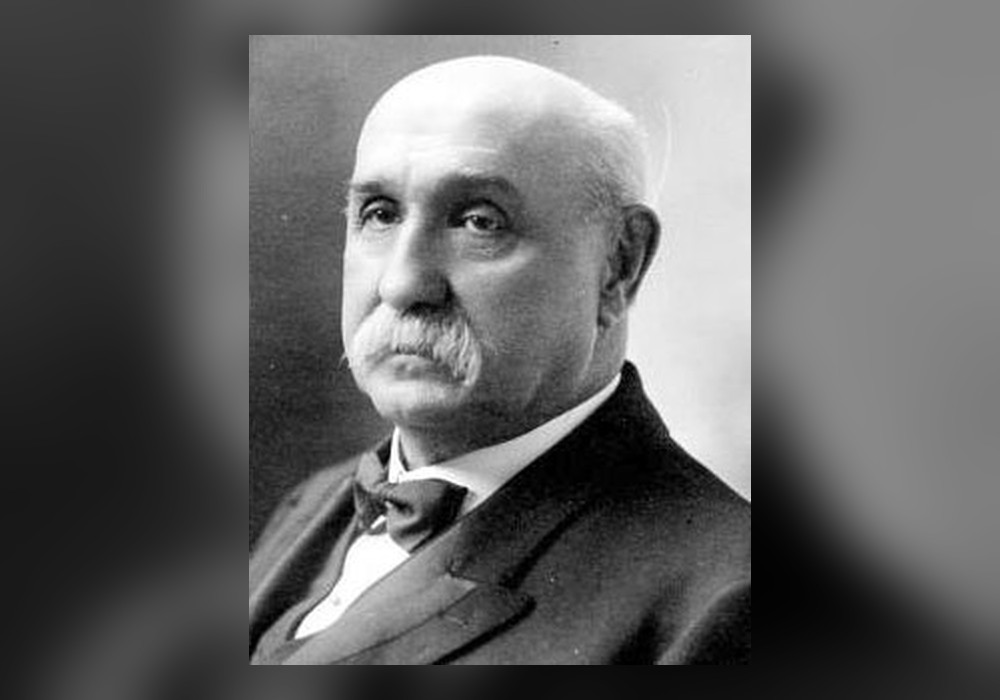 James Ritty, the Dayton saloon owner who patented the cash register with his brother John in 1879. Photo: unknown author, public domain, via Wikimedia Commons.
The bell was the whole point
This is the part I love. The brothers wrote it right into their patent: "Connected with the machine is a bell or other sounding device, which is operated whenever any of the keys are moved sufficiently to indicate their respective values, so that, if the bell or other alarm is not sounded, the customer is aware that the amount paid has not been properly recorded by the clerk or salesman."
Read that again. The bell wasn't for the bartender. It was for the guy on the stool. Ritty turned every customer in the room into a free security guard, and all they had to do was listen. A bartender who quietly pocketed your dime now had to explain to the whole bar why nothing went ding.
The patent was granted Nov 4, 1879, as U.S. Patent 221,360. The brothers sold their machine as "Ritty's Incorruptible Cashier," a name that tells you everything about how Ritty felt about his staff. Later models swapped the counting wheels for a paper roll that recorded sales, plus numbers that popped up so the customer could see the amount.
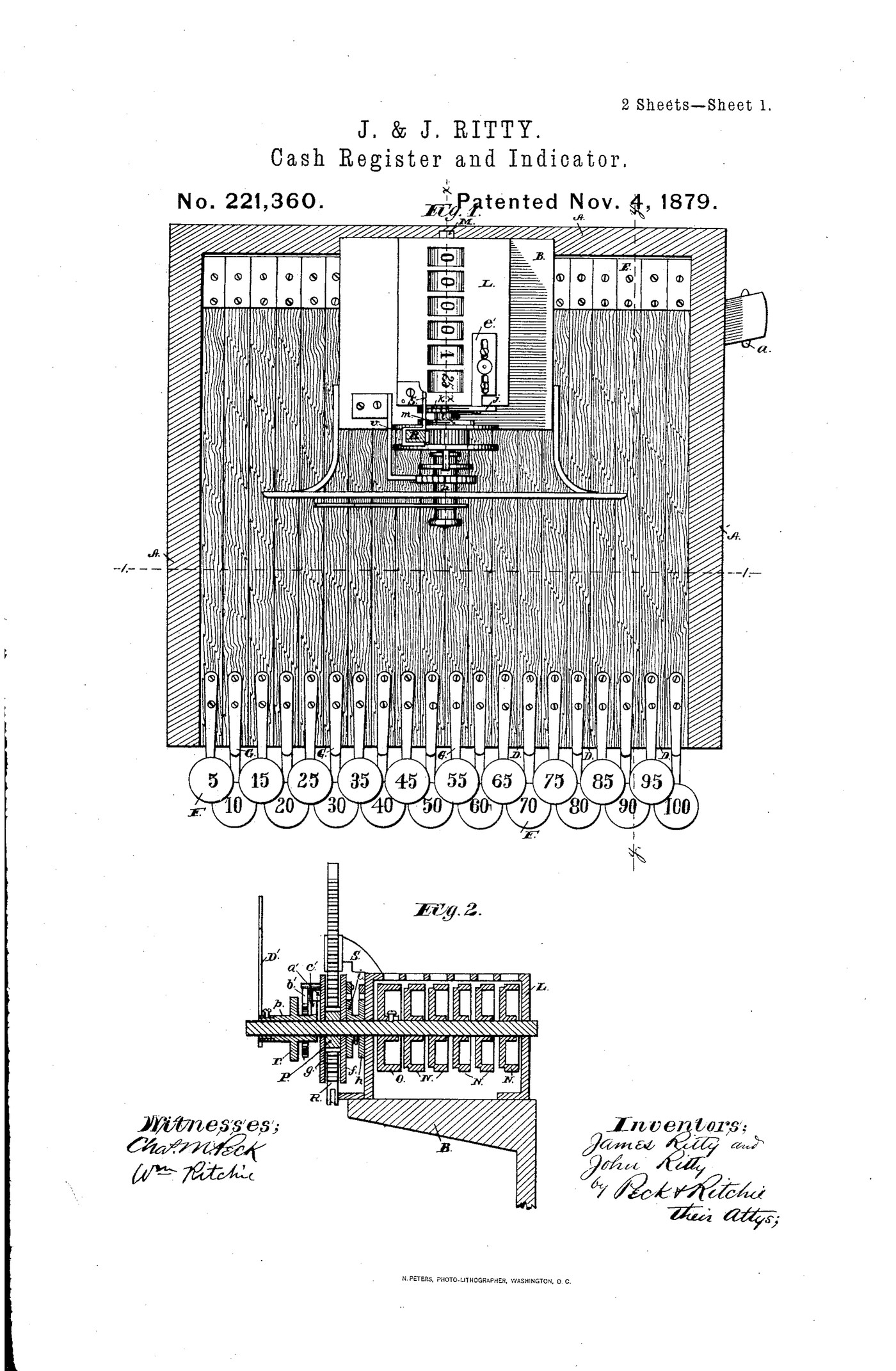 A drawing from the Ritty brothers' 1879 patent for their "Cash Register and Indicator." Image: U.S. Patent and Trademark Office, public domain.
What it means for you
Ritty's bell still exists. It just moved. Today, the "ding" is the screen that faces you at checkout and the receipt that prints when you pay. Glance at that screen before you tap your card. It's the same deal Ritty offered in 1879: if the number's wrong, speak up before you walk away.
Your bank can be the bell too. Many bank and credit card apps let you turn on an alert for every purchase, so your phone buzzes soon after a charge goes through. If you see one you didn't make, you'll know right away instead of a month later when the statement arrives. This is worth setting up on a parent's phone too, because a strange charge is often the first sign of a scam.
Nobody wanted it
The Incorruptible Cashier had one flaw. Hardly anyone bought it.
Ritty was trying to run a busy saloon and a brand-new cash register business at the same time, and it wore him out so thoroughly that in 1881 he sold his rights to the machine he'd built. The new owners added a cash drawer, which feels obvious in hindsight, and sales still went nowhere.
Then, in 1884, a Dayton businessman in the coal trade named John H. Patterson bought the business. Patterson had been one of the Ritty brothers' first customers. He renamed it the National Cash Register Company, and NCR soon ruled the cash register business.
Ritty didn't get rich from any of it. He went back to pouring drinks full-time and opened a fancier bar in 1882, the Pony House, with a backbar made from 5,400 pounds of Honduras mahogany, carved by woodworkers from a Dayton railroad car company. By the accounts we found, he held no grudge. He stayed friendly with Patterson, who invited him to NCR events. He retired from the bar business in 1895 and died in 1918.
The salesman
One more thing about that cash register company.
Years later, a young man with no formal education talked his way into an entry-level job at NCR, selling the machines Ritty had dreamed up on that steamship. He turned out to be very, very good at it, and within a few years he was a branch manager. In 1914, after he and NCR parted ways, he was hired to run a stalled, debt-heavy outfit called the Computing-Tabulating-Recording Company.
In 1924, he renamed it International Business Machines. His name was Thomas J. Watson, and he ran IBM for 42 years.
IBM went on to build some of the most famous computers ever made. And the man who built IBM learned his trade selling a machine invented in a Dayton saloon, by a guy who didn't trust his bartenders.
Enjoyed this? Follow Tech Cheat Codes on TikTok for quick tech tips: Follow on TikTok. Or open TikTok and search "Tech Cheat Codes".
References
- Source: U.S. Patent 221,360, James Ritty and John Ritty, "Improvement in Cash Register and Indicator," Nov 4, 1879, via Google Patents (bell quote, running-total wheels, application filed March 26, 1879)
- Source: U.S. Patent 221,360, full patent text and drawing (PDF scan via History-Computer)
- Source: National Museum of American History, "Cash and Credit Registers" (propeller counter on a 1878 voyage, brother John, clock-like face, keys from 5 to 95 cents and $1 to $9, "Ritty's Incorruptible Cashier," paper tape and pop-up numbers, rights sold 1881, cash drawer added, Patterson bought it in 1884 and was one of the first customers)
- Source: National Inventors Hall of Fame, "James Ritty" (1878 steamboat trip to Europe, third prototype worked, no cash drawer, overwhelmed by two businesses)
- Source: National Inventors Hall of Fame, "Who Invented the Cash Register?" (John Ritty, a skilled mechanic)
- Source: Dayton Vistas, "Who Invented the Cash Register? Meet James Ritty, a Dayton Saloonkeeper" (second floor above 10 South Main St., Patterson in the coal and railroad trade, no resentment, invited to NCR events, retired 1895, died 1918)
- Source: Dayton Vistas, "James Ritty's Pony House Saloon" (Empire Saloon at 10 S. Main St., Pony House opened 1882, 5,400 pounds of Honduras mahogany, Barney and Smith Car Works carvers)
- Source: Dayton Daily News, "Dayton's historic Pony House bar is centerpiece of Jay's Restaurant"
- Source: IBM, "The origins of IBM" (Watson had no formal education, talked his way into an entry-level role at NCR, hired to run C-T-R in 1914, renamed it IBM in 1924, CEO for 42 years)