
On this page · 4 sections
Ninety-one years ago tomorrow, on Nov 6, 1935, radio engineers packed into the Engineering Societies Building on West 39th Street in Manhattan for a talk that promised something AM radio still could not deliver: sound without the crackle. Edwin Howard Armstrong stood on stage with a tangle of prototype FM receiver modules on tables behind him. There was no transmitter in the hall. The signal was coming from about 17 miles away, from his friend C. R. "Randy" Runyon's amateur station W2AG in Yonkers. (Some radio histories list the date as Nov 5. Armstrong's own published paper puts it on Nov 6.)
Then the room heard the difference.
First came live speech from Yonkers over his wideband frequency-modulation set, clean, with none of the hiss and crackle New York listeners lived with. Then Armstrong played recorded samples of the same program over AM and over FM. Two different ways of carving sound into a radio wave. One drowned in static. One sounded as if the studio were next door.
He had already reinvented the radio twice
Armstrong was not a newcomer asking for a polite listen. Born in Manhattan in 1890 and raised partly in Yonkers, he earned an electrical engineering degree from Columbia and kept a lab in the basement of Philosophy Hall. As an undergraduate he worked out the regenerative circuit, which fed a little of a tube's output back into its input so faint wireless signals got loud enough to matter. During World War I, while serving with the Army Signal Corps in France, he invented the superheterodyne receiver. That trick converts a high incoming frequency down to a fixed middle frequency you can amplify cleanly, and it still sits inside many broadcast radio and television tuners. By the early 1920s those patents had made him rich enough to fund the next fight himself.
That next fight was static.
AM radio changes the strength of the carrier wave to carry sound. Lightning does it. Elevators and car ignitions do it too, along with a city's worth of other sparks. The noise rides along with the music. For years the smart money insisted better filters would fix it. Armstrong decided the modulation itself was the wrong tool. His answer was wideband frequency modulation: keep the power steady and wiggle the frequency over a wide swing instead. Spread the signal, strip the amplitude junk with a limiter at the receiver, and the static that had owned AM had far less to grab. Four basic FM patents issued to him on Dec 26, 1933. He spent the next couple of years proving the idea was not a lab toy.
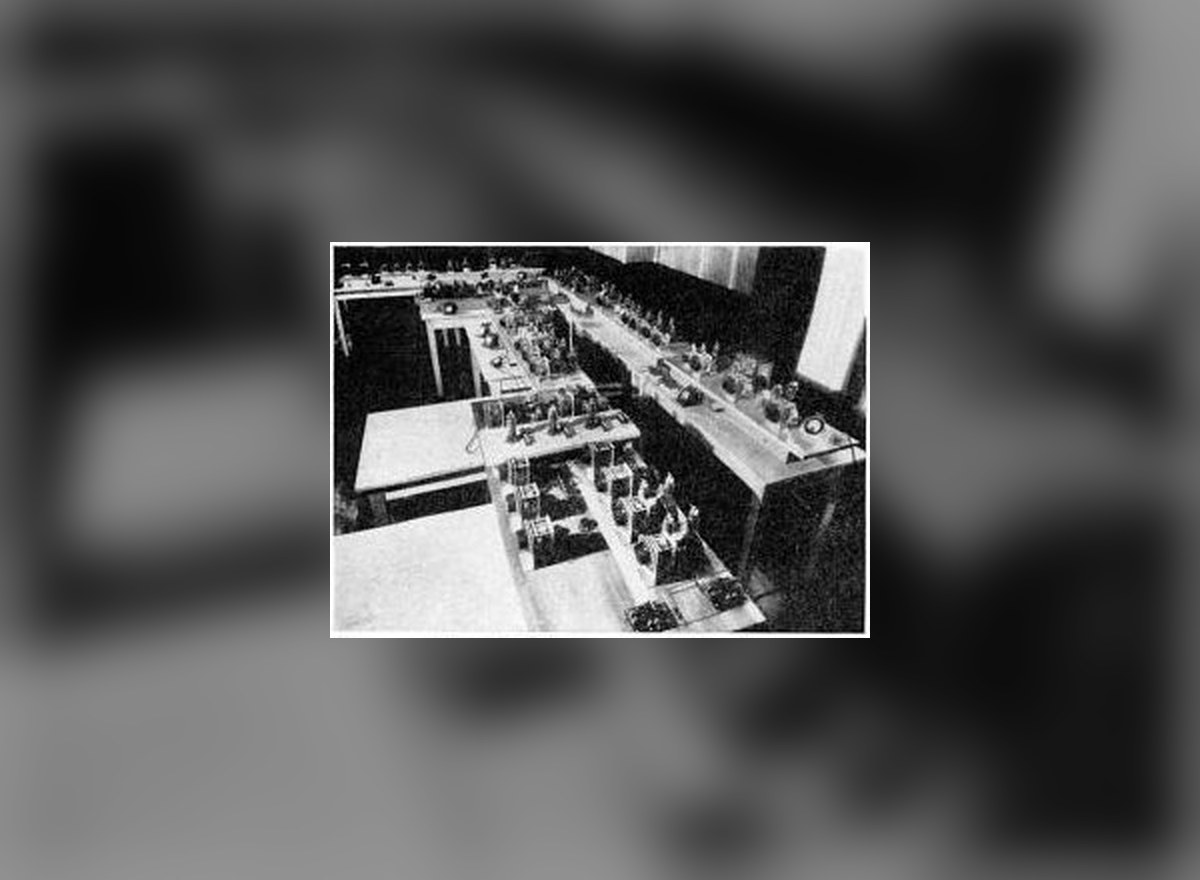 Armstrong's experimental FM transmitter, photographed in 1935 during his W2XDG tests at the Empire State Building. Photo: unknown author, Popular Science, July 1935 (copyright not renewed), public domain, via Wikimedia Commons.
The demo that made the gap audible
Private tests had already run. In 1934 and 1935, RCA let Armstrong use experimental gear atop the Empire State Building. Those trials produced recorded comparisons of the clean ultra-high-frequency FM channel against the noisy AM broadcast band. What the Institute of Radio Engineers' New York section got in November 1935 was the public version.
Armstrong read a draft of the paper he would publish the next May in the Proceedings of the Institute of Radio Engineers, titled "A Method of Reducing Disturbances in Radio Signaling by a System of Frequency Modulation." Runyon sent staticless speech from the Yonkers living-room studio and yard tower. Armstrong then played the recorded AM-versus-FM samples so the room could hear the same program material two ways. Trade press called it a dramatic, convincing demonstration. The reproduction sounded as good as the best broadcast stations of the day, with a noise floor that New York's electrical mess could not bury.
Notice what that demo was not. Later FM shows, including a 1939 apartment listen for The New Yorker, leaned on parlor tricks like poured water and crumpled paper. The IRE afternoon was more austere: live speech from Yonkers, then hard A/B proof on recordings. It was enough. Engineers who had only read magazine blurbs about FM heard the gap for themselves.
Clear sound, cold industry
Hearing it and wanting it were different businesses.
Armstrong had shown the system privately to David Sarnoff and RCA engineers in 1933 and 1934. The lab people were impressed. The company had a fortune sunk in AM broadcasting and a bigger bet on television. Wideband FM meant a new crop of transmitters and receivers, plus a threat to the dial everyone already owned. Better sound looked like a luxury in a Depression market, and RCA did not want a second radio rebuild while it chased TV. After the Empire State tests, the firm asked Armstrong to clear out so the space could go to television work. He built his own high-power experimental station instead, W2XMN, with a 400-foot tower on the Palisades in Alpine, New Jersey. Regular FM broadcasts from Alpine began in 1939. Other early stations followed in New England and beyond. The AM establishment still moved slowly. Postwar frequency shifts and patent fights chewed more years off FM's early momentum.
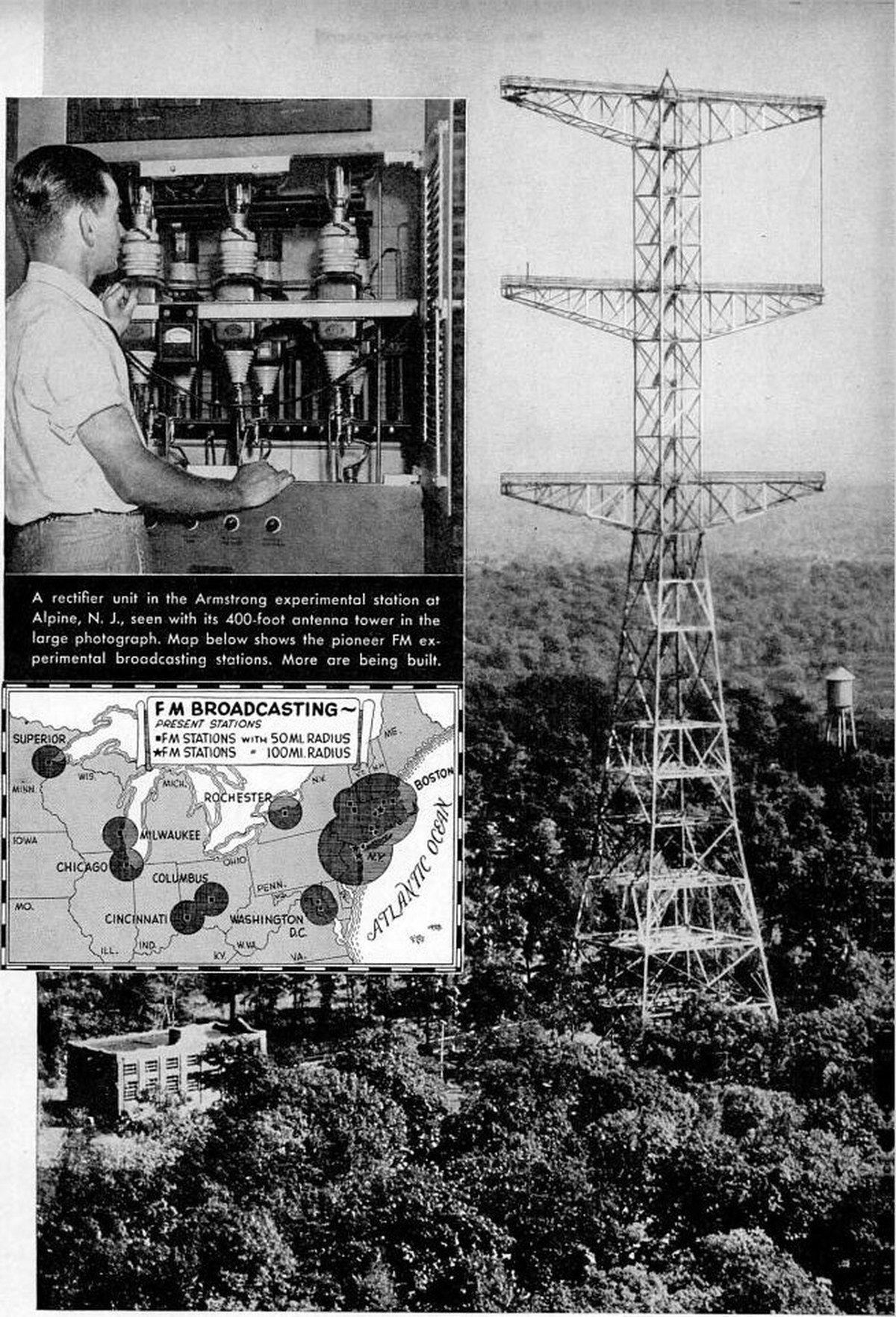 Armstrong's experimental FM station W2XMN in Alpine, New Jersey, as shown in Popular Science in November 1940. Image: E. W. Murtfeldt / Popular Science (copyright not renewed), public domain, via Wikimedia Commons.
None of that erases what happened in the hall on West 39th. The physics did not need RCA's blessing. Frequency modulation carried the sound. Amplitude modulation carried the static. Once enough people heard both in the same room, the old excuse that "radio just sounds like that" started to look thin.
Here's the twist. The company had sent Armstrong packing from the Empire State Building to make room for television. Then in 1941, when the government wrote the rules for American TV, it picked FM to carry the sound. For the next several decades of analog broadcasts, the sound on American TV rode on the idea RCA had pushed out the door.
The static lost. It just took a while for everyone else to hear it.
Enjoyed this? Follow Tech Cheat Codes on TikTok for quick tech tips: Follow on TikTok. Or open TikTok and search "Tech Cheat Codes".
References
- Source: We Are Broadcasters / NAB #Radio100 Moment 91, "Edwin H. Armstrong Publicly Demonstrates FM Radio (November 5, 1935)" (IRE New York section presentation and public FM demo date)
- Source: John F. Schneider, "Early FM Radio," theradiohistorian.com (Nov 5, 1935 IRE demo; W2AG Yonkers about 17 miles away; private RCA demos 1933–34; Empire State tests then vacate for TV; Alpine W2XMN; industry resistance led by RCA/Sarnoff)
- Source: IEEE Engineering and Technology History Wiki, "Technical tour - Edwin Howard Armstrong" (Engineering Societies Building, 25–33 West 39th Street; first public FM demo; Empire State W2XDG tests 1934–35; Runyon amateur station; Alpine W2XMN)
- Source: A. Michael Noll / Radio Club of America archive note via oldradio.com eha64 (Nov 5, 1935 IRE New York section paper and demo; transmission from Randy Runyon's Yonkers amateur station)
- Source: Edwin H. Armstrong, "A Method of Reducing Disturbances in Radio Signaling by a System of Frequency Modulation," Proceedings of the IRE (paper received Jan 15, 1936; footnote presents New York meeting date as November 6, 1935 — see NOTES)
- Source: U.S. Patent 1,941,066, Edwin H. Armstrong, "Radio Signaling System," filed July 30, 1930, granted Dec 26, 1933, via Google Patents (one of the four same-day wideband FM patents)
- Source: National Inventors Hall of Fame, "Edwin Howard Armstrong" (Columbia 1913; regenerative circuit; 1918 superheterodyne; 1933 wide-band FM; independently wealthy on royalties)
- Source: Columbia Magazine, Yannis Tsividis, "Edwin Armstrong: Pioneer of the Airwaves," Spring 2002 (Philosophy Hall lab; regenerative and superheterodyne; FM work at Columbia)
- Source: IEEE-USA InSight, "Engineering Hall of Fame: Edwin Howard Armstrong" (four FM patents Dec 26, 1933; RCA sales/legal saw FM as threat; Sarnoff prioritized television)
- Source: Gary L. Frost, Early FM Radio (Muse chapter excerpt): Engineering Societies Building afternoon demo; Runyon house transmitter in Yonkers ~20 miles; staticless speech plus recorded AM/FM film comparisons; RCA attendees; Electronics and Communication and Broadcast Engineering coverage; Lessing's water/paper account inaccurate for this event
- Source: Armstrong v. Emerson Radio and Phonograph Corp., 179 F. Supp. 95 (S.D.N.Y. 1959), findings 99-101 (FCC authorized TV in 1941 with sound by FM)
- Source: Radio Club of America, The Legacies of Edwin Howard Armstrong (1990) (NTSC backed FM for TV sound; FCC adopted it July 1, 1941)
- Source: The New Yorker, "No Static," May 13, 1939 (later apartment demo with poured water, crumpled paper, match strike — not the 1935 IRE meeting)