
On this page · 6 sections
One hundred sixteen years ago today, on Nov 14, 1910, a young pilot named Eugene Ely sat in a little airplane on a wooden ramp. The ramp was built on the front of a Navy cruiser, the USS Birmingham. Below him was the cold, gray water of Hampton Roads, Virginia.
It was raining. Ely could not swim. The ship was not even moving.
He went anyway.
No airplane had ever taken off from a ship before. In a few seconds, one would.
A ramp made of wood
The idea came from a Navy officer named Captain Washington Irving Chambers. His job at the Navy Department was to keep an eye on airplanes. In 1910, airplanes were brand new, flimsy things made of wood, wire and cloth. Chambers wanted to know if they could go to sea.
He met Ely at an air show in New York that October, and saw him again at another show near Baltimore. Ely flew for the airplane builder Glenn Curtiss. When Ely heard that Chambers wanted a plane to fly off a ship, he offered to do it.
There was no money set aside for the test. A wealthy flying fan named John Barry Ryan paid a few hundred dollars. At the Norfolk Navy Yard, workers built a wooden ramp over the front deck of the Birmingham. It was 83 feet long. It sloped gently down from the ship's bridge toward the bow, so gravity could help. Ely would have only 57 feet to get going.
Waiting out the storm
On the morning of Nov 14, a crane lifted Ely's Curtiss biplane onto the ramp. His engine showed up late, still in its crate. Ely and his mechanics put it in while the ship steamed down the river. There was no time to test it.
The weather was awful. Low clouds rolled in. Rain came in bursts, with bits of hail. The Birmingham dropped anchor off Old Point Comfort to wait.
The plan was for the ship to steam into the wind. A moving ship would give the plane a head start. In the middle of the afternoon, the crew began to pull up the heavy anchor chain. It was slow work. Ely sat in his seat, wearing an air-filled life vest, and watched another dark storm creeping closer.
He decided he could not wait. At 3:16 p.m., with the anchor chain still out and the ship standing still, he gave the signal. The sailors let go. The little plane rolled down the ramp and off the bow.
And then it dropped.
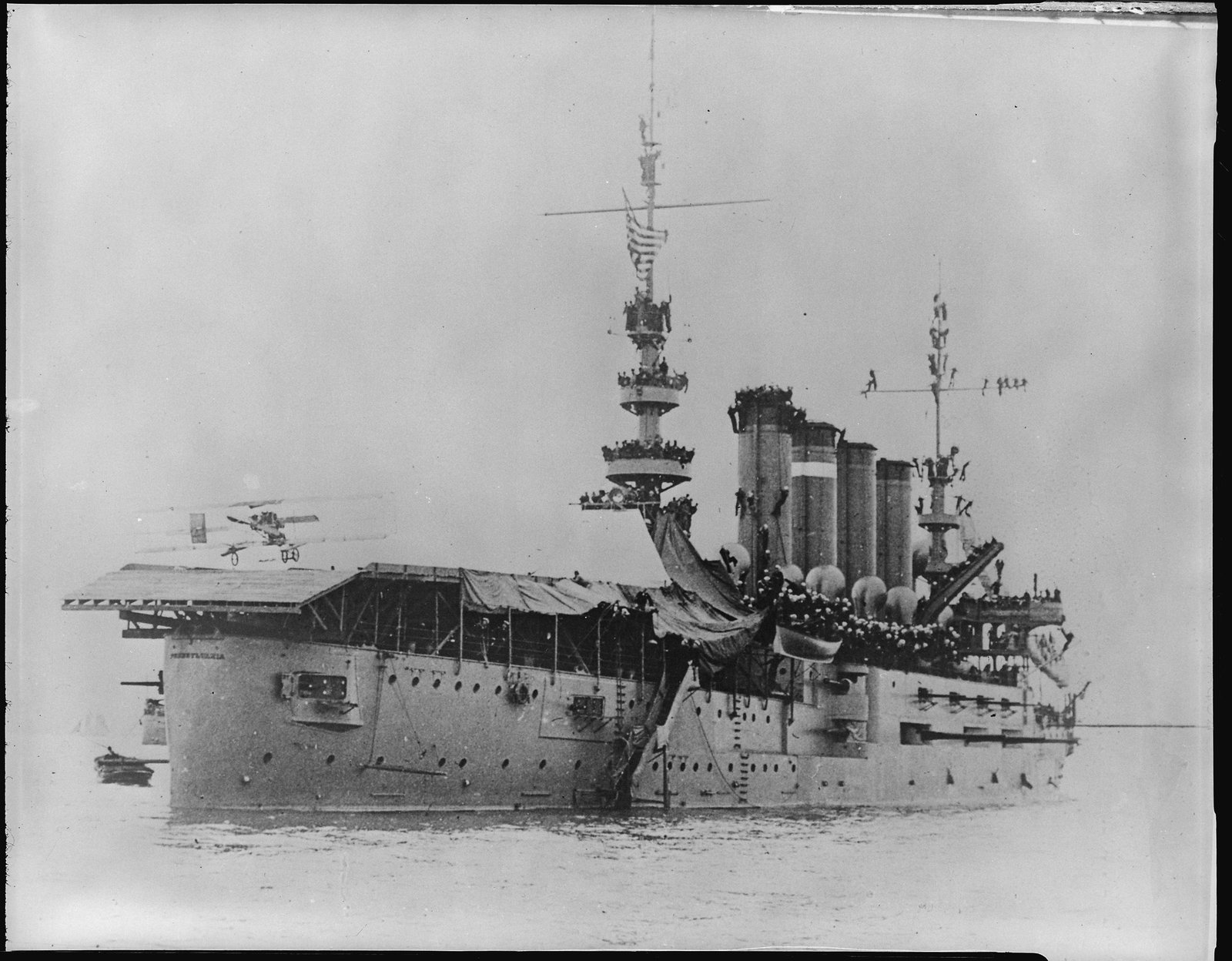 Two months later, Ely landed on the USS Pennsylvania in San Francisco Bay. Photo: U.S. Navy, Jan 18, 1911, National Archives (public domain), via Wikimedia Commons.
Wheels in the water
The plane dove toward the bay to pick up speed. It went too far. Its wheels and propeller hit the water. Spray flew up in front of the ship, and the people watching held their breath.
Salt water hit Ely in the face and covered his goggles. He tried to wipe them with his glove, but that only smeared them. He could not see. So he pulled the goggles off and kept climbing.
The plane came back up out of the spray. The tips of the propeller were splintered, and the whole machine shook. A pilot who cannot swim does not want to stay over water. Ely looked for the nearest land. About five minutes later, he set down on a sandy beach called Willoughby Spit, about two and a half miles away.
He had planned to fly all the way to the Navy Yard. Sitting on that beach with a broken propeller, he felt he had failed.
Captain Chambers did not see it that way. That evening, he and Ryan kept telling Ely it did not matter where he landed. He had flown off a ship. The next morning, Ryan gave Ely a $500 prize and kept the broken propeller as a trophy. Ely spent the money on a diamond for his wife, Mabel.
Chambers promised him another chance. Ely had an answer ready. "I could land aboard, too," he said.
Then he came back
On Jan 18, 1911, in San Francisco Bay, Ely did just that. The cruiser USS Pennsylvania had a new wooden deck over its back end. Ropes were stretched across it, each one tied to sandbags. Hooks under Ely's plane would grab the ropes, and the heavy bags would drag the plane to a stop.
Ely wore a padded football helmet. He wrapped bicycle tubes around his body in case he ended up in the bay. At 11:01 a.m., he touched down. The hooks caught. The sandbags slid. The plane stopped. Thousands of people cheered from the shore and from boats.
He ate lunch on the ship. Then he took off again and flew back to land.
Ely did not get much time to enjoy it. On Oct 19, 1911, he crashed while flying at a fair in Macon, Georgia, and died. He was two days shy of his 25th birthday. Twenty-one years later, on Feb 16, 1933, he was given the Distinguished Flying Cross for what he had done for Navy flying.
Why it matters for your tech today
Ely's two flights showed the problems every ship that carries planes still has to solve. You need a way to get a plane flying fast, in a short space. And you need a way to stop it fast, in a short space.
The fix for the first problem came quickly. On Nov 12, 1912, a Navy pilot named Theodore Ellyson was launched from a catapult at the Washington Navy Yard. It was the first successful catapult launch of an airplane.
The fix for the second problem came straight from Ely's sandbags. The Navy's history office writes that his ropes-and-hooks setup pointed the way to the arresting gear still used on its aircraft carriers. When you watch a jet slam onto a carrier and jerk to a stop in a video, a hook under the plane is catching a cable on the deck. Ropes became steel cables. Sandbags became machines. The idea stayed the same.
And the wind lesson stuck, too. Officers who watched Ely that day agreed his takeoff would have been much easier if the ship had been moving into the wind.
Want the whole story?
iThis page has affiliate links. If you buy through one, we may earn a small commission at no extra cost to you. Learn more.
- Eugene Ely, Daredevil Aviator: First Shipboard Landing and Takeoff, by William M. Miller (opens in a new tab): A 344-page paperback history of Ely's life from McFarland. Amazon lists it for adult readers. We have not read it hands-on.
Every time a pilot lands on a carrier at sea, a hook reaches down and catches a line, the way Ely's did. He was a young man who could not swim, flying a borrowed idea off a wooden ramp in the rain. He thought he had failed. He had started something that is still landing on Navy ships at sea.
Enjoyed this? Follow Tech Cheat Codes on TikTok for quick tech tips: Follow on TikTok. Or open TikTok and search "Tech Cheat Codes".
References
- Source: Naval History and Heritage Command, "Eugene Ely's Flight from USS Birmingham, 14 November 1910" (archived NHHC Online Library page: Chambers responsible for aviation at the Navy Department, met Ely at Belmont Park in October 1910 and again near Baltimore; Ely volunteered; John Barry Ryan paid a few hundred dollars; platform designed by Naval Constructor William McEntee, sloped five degrees, 57-foot run; engine installed on the way; ship anchored for weather; 3:16 PM start with ship stationary; plane touched the water, spray damaged the propeller; Ely a non-swimmer; landed on Willoughby Spit after about five minutes; 2.5-mile flight; photo NH 77601 and others)
- Source: Naval History and Heritage Command, "Naval Aviation 1898–1916" (14 November 1910: 83-foot slanted wooden platform on Birmingham at anchor off Old Point Comfort, Hampton Roads; touched the water, landed about 2.5 miles away on Willoughby Spit; splinter damage to propeller tips; 18 January 1911: same Curtiss pusher landed on Pennsylvania at anchor in San Francisco Bay at 11:01 a.m., took off again at 11:58 a.m.; photo NH 77545)
- Source: Naval History and Heritage Command, National Naval Aviation Museum, "Eugene Ely Makes Naval Aviation's First Shipboard Launch" (archived: wheels and propeller struck the water)
- Source: Naval History and Heritage Command, "Eugene Ely's Flight to USS Pennsylvania, 18 January 1911" (archived NHHC Online Library page: ropes with sandbags at each end, hooks on the landing gear; arrangement pointed the way to the arresting gear and barrier system on Navy aircraft carriers to this day; lunch aboard)
- Source: Naval History and Heritage Command, "January 18" (Today in Naval History: Pennsylvania landing, hooks engage ropes weighted by sandbags; Ely died months later in a crash at an aerial exhibition in Macon, Georgia)
- Source: Naval History and Heritage Command, "The Aeroplane Goes to Sea" (PDF: low clouds and showers mixed with hail on Nov 14, 1910; skid framing and pontoons struck the water, prop tips splintered, water over his goggles; Willoughby Spit; Ellyson's successful catapult launch of the A-3 at the Washington Navy Yard on 12 November 1912)
- Source: Naval History and Heritage Command, "Ely, Eugene B., Aviator (1886–1911)" (archived NHHC Online Library page: killed in a crash at Macon, Georgia, on 19 October 1911; posthumous Distinguished Flying Cross in 1933)
- Source: National Archives, The Text Message blog, Greg Bradsher, "The First Aeroplane Take Off from a Ship, November 14, 1910, Part II" (83 by 24 ft platform, 57 ft run; engine arrived crated and untested; Captain Fletcher anchored off Old Point Comfort; pneumatic life preserver; anchor chain still out; glove smeared his goggles and he pulled them off; landed on Willoughby Spit after about five minutes and 2.5 miles; felt he had failed; Chambers and Ryan said it made no difference where he landed; "I could land aboard, too"; Ryan's $500 check and the broken propeller; diamond for his wife; officers agreed a moving ship would have made the takeoff easier)
- Source: Smithsonian National Air and Space Museum, "Eugene Ely and the Birth of Naval Aviation—January 18, 1911" (ropes and sandbags as arresting system; padded football helmet and bicycle inner tubes; thousands of spectators; lunch, then takeoff back to Tanforan)
- Source: Library of Congress Name Authority File, "Ely, Eugene Burton, 1886-1911" (born Oct. 21, 1886; died Oct. 19, 1911, in Macon, Georgia; Distinguished Flying Cross awarded posthumously on Feb. 16, 1933; cites the W.I. Chambers Papers at the Library of Congress)
- Source: U.S. Naval Institute, Naval History, "The Navy's First" (June 2024: Ellyson's Nov 12, 1912 flight of the A-3 from a catapult at the Washington Navy Yard was the first successful catapult launch of an aircraft)