On this page · 5 sections
At about 10:30 on the night of Oct. 29, 1969, by the lab's own log, a UCLA programmer named Charley Kline sat at a Teletype in a lab in Boelter Hall, put on a telephone headset and typed the letter L. Then he asked a man 350 miles away whether it had shown up.
"Got the L," came the answer. Kline typed an O. "Got the O." He typed a G.
The computer at the other end crashed. What had gone through was two letters, "lo," and that is the first message ever sent over ARPANET, the research network that grew into the internet.
What this means for you
Nothing to update or fix today. This one is about where the thing in your pocket started, and it started with a login that failed halfway. The next time a sign-in screen hangs on you, remember that the very first login across a network hung too, and somebody fixed it that same night.
Two computers that had no common language
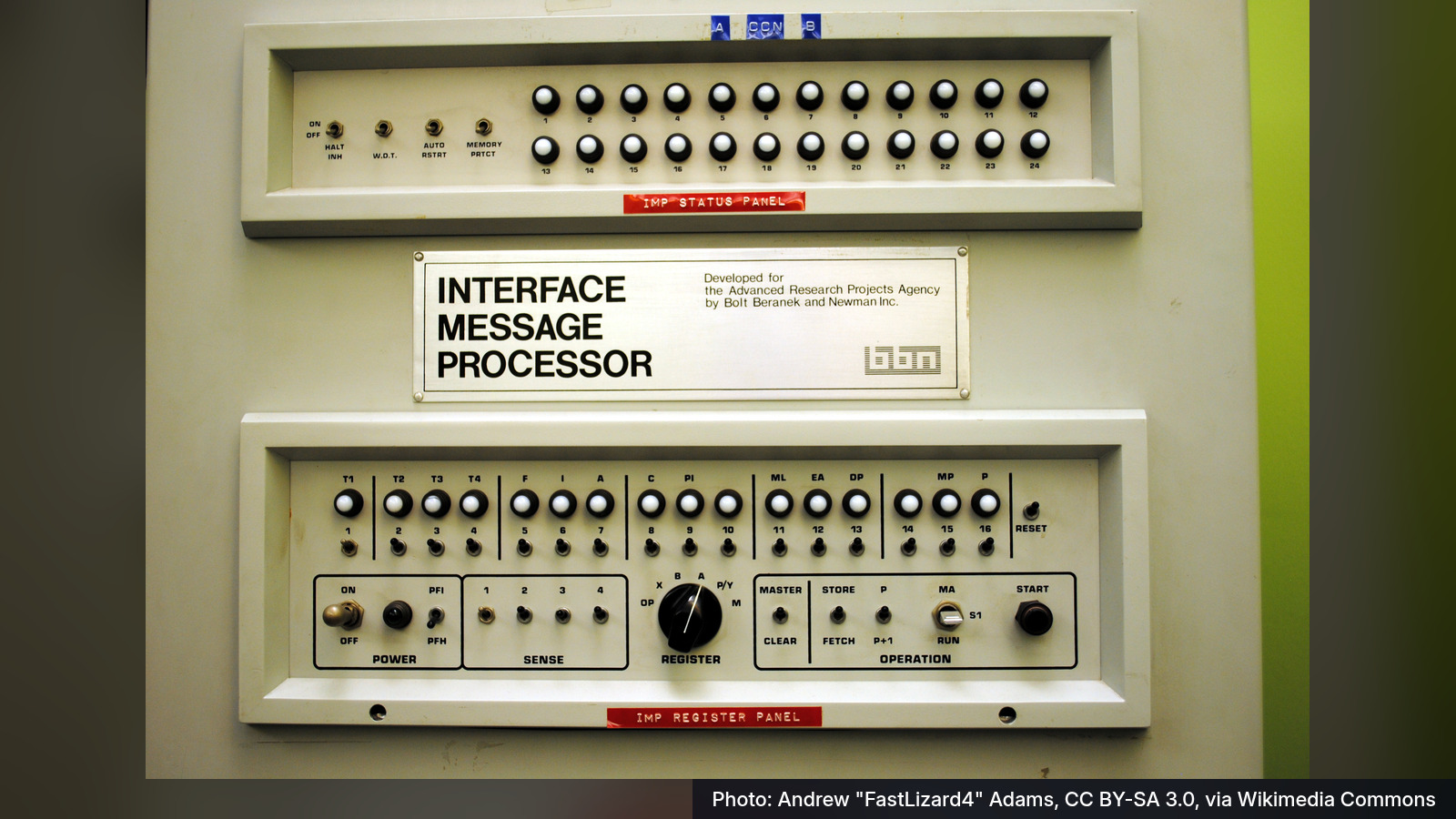
ARPA, the Pentagon's research agency, wanted its scientists to share expensive computers instead of each asking for their own. It hired the Cambridge firm Bolt, Beranek and Newman (BBN) to build the boxes that would sit between each computer and the network. Those boxes were called Interface Message Processors, or IMPs. Each one was a Honeywell minicomputer, ruggedized and loaded with special software, and the one UCLA got was about the size of a refrigerator.
UCLA went first because Leonard Kleinrock worked there. He'd been writing about breaking messages into small pieces since his MIT days, and ARPA wanted his lab to be the place that measured how the network behaved. BBN was running two weeks late, but it shipped IMP No. 1 by air instead of by truck, and it landed on time, on Saturday, Aug. 30, 1969. By the Tuesday after Labor Day, bits were moving between the IMP and UCLA's host computer, an SDS Sigma 7. Nothing was standard yet, so the UCLA team built the 15-foot cable between the two machines themselves.
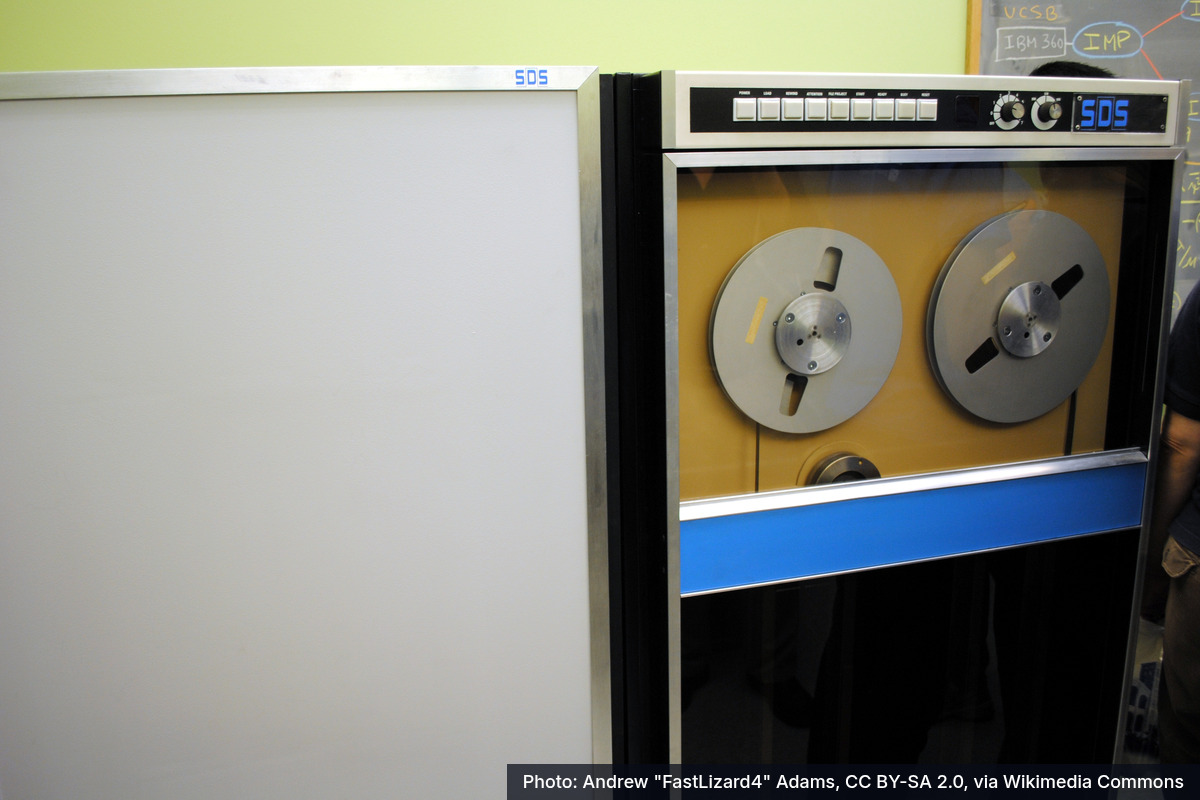 An SDS Sigma 7 on display in Room 3420 at UCLA. The museum filled the room with replicas of mainframes, so this may be a stand-in for the original. Photo: Andrew "FastLizard4" Adams, CC BY-SA 2.0, via Wikimedia Commons.
The second IMP went to the Stanford Research Institute (SRI) in Menlo Park, in early October, to be wired to an SDS 940 that Bill Duvall was programming. His team and UCLA's had committed to a first transmission by Oct. 31. "It was one of those intense things that happen in software, which is 15-hour days every day for however long it takes," Duvall recalled.
The two machines didn't even agree on how to write the alphabet. UCLA's Sigma 7 used IBM's EBCDIC code, and SRI's computer used ASCII, which Kline said "also became the standard of the ARPANET and pretty much the world." Translating between the two was the first bug he had to fix. The line between them was a leased AT&T circuit that Kleinrock remembers running at "the blazing speed of 50,000 bits per second." A phone call ran alongside it so the two men could talk.
The night of the crash
They picked an evening on purpose. If one of the computers fell over, nobody's daytime work would go with it. The first test was set for Oct. 29, which left three spare days before the deadline, and Duvall called the software "pre-alpha" at that point.
SRI's computer had a trick. When you typed L, O and G, it finished the word on its own, sending back the "IN" for LOGIN. So Kline only had to send three letters. He asked after each one, and the L came back and printed on his own terminal. After the O, Duvall's system was still fine. After the G, it wasn't. As Kline remembered it, the reply was "Wait a minute, my system crashed." Duvall traced the problem to a buffer overflow, a program running out of room to hold what it was being sent, and called it "a very simple thing to detect and fix."
Kline's log is the only record of the night. Nobody filmed it or taped the phone call. The entry is a few lines of handwriting on a lined page, timed 22:30, and it reads "Talked to SRI host to host," initialed CSK. It doesn't say "lo." That part comes from the two men's memories, which match each other.
The sources split on how long the fix took. Kline remembers about 20 minutes. Kleinrock has written that the full login worked about an hour later. A Computer History Museum release from 2009 puts Kline's first attempt closer to 9 p.m., with the connection fully up by 10:30, which doesn't match the log entry, so the time of the first try is the one detail here that isn't settled. When Duvall called back, Kline started over. "I typed the L and the O and the G, but this time I got back the I N," he said. The login worked, Duvall had set up an account for him on the SRI machine, and Kline ran a few programs there. "By that time, it was getting late, so I went home."
Neither of them made much of it. "I don't remember anything specifically memorable about that night, and I certainly didn't realize that what we had done was anything special at the time," Kline said. Duvall said the bug wasn't the point: "This is about the fact that the ARPANET works." Kleinrock's description of the mood was "just engineers working."
Kleinrock saw something in the two letters. "We hadn't prepared a special message ... but our 'lo' could not have been a more succinct, a more powerful or a more prophetic message," he wrote in 2019. It reads as "lo and behold," though nobody planned it.
What the two letters started
By December 1969 the network had four sites: UCLA, SRI, UC Santa Barbara and the University of Utah. By 1972 it had 37. Kleinrock's lab was charged with stress-testing it, and in those early days he could bring the whole thing down at will, then track down the fault. Some of the faults he found got names, like Christmas Lockup and Piggyback Lockup.
Email, bolted on informally, soon dominated the traffic. SRI's group ended up keeping the list of every computer on the network, a job that later turned into the Domain Name System, the address book behind every web address today.
Plenty of the researchers ARPA wanted on the network hadn't wanted to be on it. Many refused at first to let outside traffic touch their computers, which Kleinrock recalls were already fully used by their own people. They relented.
Room 3420 in Boelter Hall was restored in 2011 and now holds IMP No. 1, the one that carried the message. Nobody photographed the night. In Kleinrock's words: "Heck, we didn't have a camera or even a voice recorder."
References
- Source: Leonard Kleinrock, "The First Message Transmission," ICANN blog (Oct. 29, 2019)
- Source: Leonard Kleinrock, "The Day the Infant Internet Uttered its First Words" (UCLA, with IMP log excerpt)
- Source: Leonard Kleinrock, Personal History / Biography: the Birth of the Internet (UCLA)
- Source: "50 years ago today, the internet was born in Room 3420," Fast Company (Nov. 2019; interviews with Kline, Duvall and Kleinrock; mirrored by Impact Lab)
- Source: Computer History Museum, "The First 50 Years of Living Online: ARPANET and Internet" (Oct. 25, 2019)
- Source: Computer History Museum, "The Computer History Museum, SRI International, and BBN Celebrate the 40th Anniversary of First ARPANET Transmission" (2009)
- Source: UCLA Samueli School of Engineering, "Archive Illuminates UCLA's Place in Internet History" (Nov. 9, 2011)
- Source: UCLA Samueli School of Engineering, Internet50 Photo Gallery (IMP log entry, Oct. 29, 1969)
- Source: Leonard Kleinrock, "The First Two Packets on the Internet," IEEE Computer (2014)
- Source: Interface Message Processor, Wikipedia (IMP delivery dates, Honeywell DDP-516 hardware)