
On this page · 6 sections
One hundred twenty-two years ago today, on Nov 16, 1904, a professor in London applied for a patent on an odd little light bulb. It did not make much light. What it did was stranger. It let electricity flow in only one direction.
His name was John Ambrose Fleming. His bulb became the first vacuum tube. Tubes like it went on to become a mainstay of electronics.
And the idea came out of a cupboard.
A mystery inside a light bulb
The story starts with Thomas Edison. In the early 1880s, Edison noticed black soot building up inside his light bulbs. He wanted to know why. So he sealed an extra piece of metal inside a bulb, near the glowing wire.
A tiny current jumped across the empty space inside the bulb to that metal. But it only went one way. People called it the Edison effect. Edison patented the bulb, but he did not do much with it.
Fleming did. He had worked as an adviser to Edison's electric light company in London from 1881 to 1891. He studied the Edison effect for years. By 1890, he had shown that this kind of bulb could act like a one-way gate for electricity. Then he put his test bulbs away. Nobody had a use for them yet.
A problem with no answer
By 1904, Fleming was also an adviser to the Marconi company. Marconi was sending Morse code messages through the air with no wires, even across the Atlantic Ocean. But the signals that arrived were very weak. The gadgets used to catch them were clumsy. One kind was a glass tube of metal bits that had to be tapped after every signal to work again.
The signal was also too fast to measure. It flipped back and forth, over and over. A meter needle could not keep up, so it just sat still. Fleming needed a way to make the current flow in one direction only. Then a meter could show it.
He tried other tools. They did not work at those speeds.
The cupboard
Then, in October 1904, Fleming had what he later called "a sudden very happy thought." He remembered his old bulbs. If electricity could only cross the empty space inside them one way, maybe they could sort out the fast signal.
"I asked my assistant, Mr. G. B. Dyke, to put up the arrangements," Fleming said later, "and I took out of a cupboard one of my old experimental bulbs."
It worked. The bulb turned the back-and-forth current into a one-way current that a meter could read.
Fleming called his bulb a valve. He said it worked on electricity the way a valve in a pump works on air or water. It lets the flow go one way, but not back. On Nov 16, 1904, he applied for a British patent. A U.S. patent followed on Nov 7, 1905.
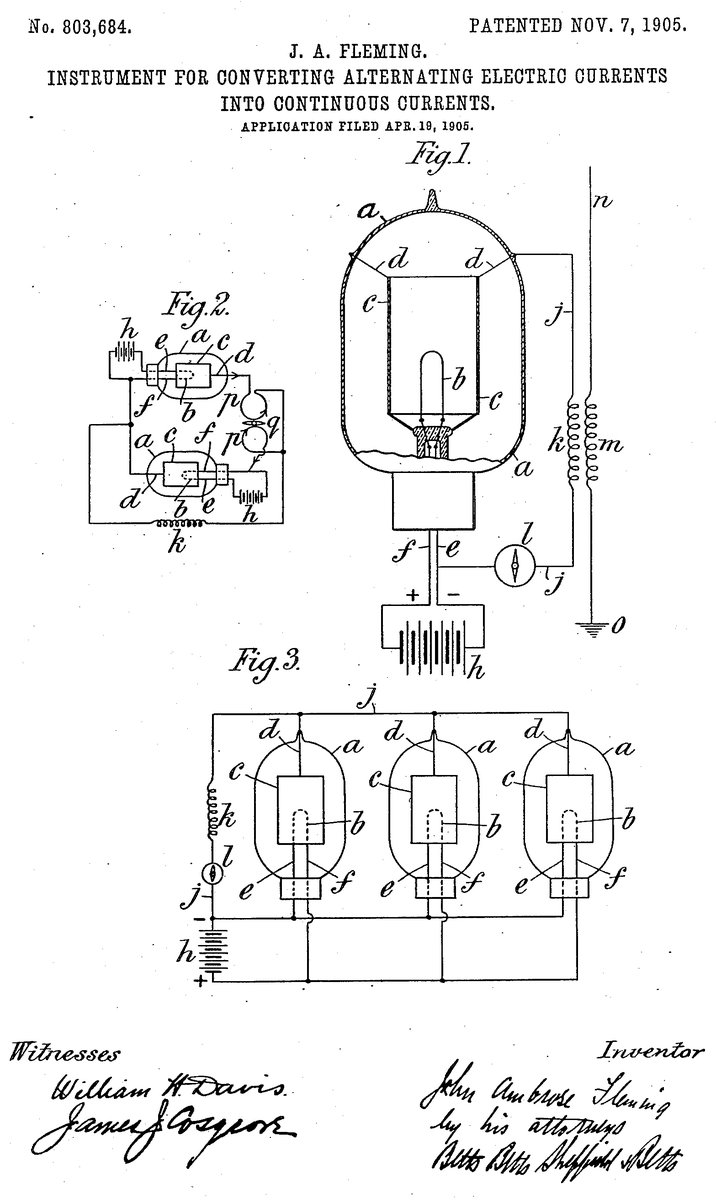 The first page of Fleming's U.S. patent, granted Nov 7, 1905. Image: U.S. Patent Office (public domain), via Wikimedia Commons.
From one bulb to everything
Fleming's valve could do one job. In 1906, an American named Lee de Forest read about it and added a third part. His new tube could make weak signals stronger. Tubes became a mainstay of electronics, and stayed that way well into the age of the transistor.
Some of Fleming's first valves still exist. They are at the Science Museum in London. Look closely, and you can see they were made from plain carbon-filament light bulbs, built by the Edison and Swan company back in 1889.
Why it matters for your tech today
Fleming's valve was the first diode. A diode is a part that lets electricity go one way only. Your gadgets are full of them now, in much smaller forms. You probably have one shining right over your head.
LED stands for light-emitting diode. The U.S. Department of Energy says LED bulbs use at least 75% less energy than old-style incandescent bulbs and last 25 times longer.
If you are swapping old bulbs for LEDs, the Department of Energy has one tip that helps a lot. Shop by lumens, not watts. Watts tell you how much power a bulb uses. Lumens tell you how bright it is. To replace an old 75-watt bulb, the DOE says to look for about 1,100 lumens.
Helpful gear
iThis page has affiliate links. If you buy through one, we may earn a small commission at no extra cost to you. Learn more.
- Philips Hue Essential Smart LED A19 Bulb (1-pack) (opens in a new tab): Optional. A color smart LED bulb with a standard E26 base. The listing rates it at 800 lumens and 8.8 watts, and says it works with Alexa, Google and Apple Home. In its hands-on review, TechRadar called the Hue Essential bulbs "fantastic value" but noted they dim only to 2%, compared with 0.2% for regular Hue bulbs.
Fleming went looking for an answer to a radio problem. He found it on a shelf, in a light bulb he had put away years before. He did not know he was holding the start of electronics.
More than a hundred years later, the best light bulb you can buy is a diode, too. The idea that came out of an old bulb found its way back into the bulb.
Enjoyed this? Follow Tech Cheat Codes on TikTok for quick tech tips: Follow on TikTok. Or open TikTok and search "Tech Cheat Codes".
References
- Source: IEEE / Engineering and Technology History Wiki, "Milestones: Fleming Valve, 1904" (Fleming at University College London studied the Edison effect from the 1880s; consultant to the Edison Electric Light Company 1881-1891 and to the Marconi Wireless Telegraph Company from 1899; Edison effect discovered 1883; on 16 November 1904 Fleming applied for a patent for what he named an oscillation valve; detected Morse code messages; Lee de Forest read Fleming's 1905 paper and in 1906 made a three-element tube that could amplify; laid the foundation of electronics)
- Source: H. Frederick Dylla and Steven T. Corneliussen, "John Ambrose Fleming and the Beginning of Electronics," Thomas Jefferson National Accelerator Facility, U.S. Department of Energy OSTI (published in J. Vac. Sci. Technol. A 23, 2005) (in 1890 Fleming showed the diode could rectify; Nov 16 patent application; called it a valve by analogy to a valve in a pump for air or water; quotes Fleming via his biographer MacGregor-Morris: October 1904 "a sudden very happy thought," "I asked my assistant, Mr. G. B. Dyke, to put up the arrangements... and I took out of a cupboard one of my old experimental bulbs")
- Source: Science Museum Group Collection, "Three original thermionic valves invented by Sir John Ambrose Fleming" (valves devised in 1904 using filament lamps made by the Edison and Swan United Electric Light Company, London, in 1889; weak transatlantic signals after 1901; 'sudden and very happy thought'; the first diode; a mainstay of electronics well into the solid-state era)
- Source: IEEE Spectrum, Justin Mullins, "The First Electronic Device, Ever?" Dec 1, 2006 (Edison curious about soot inside bulbs; added an extra electrode that caught current flowing one way; patented as the Edison effect lamp but did not pursue it; Marconi hired Fleming as a consultant; coherer of iron filings had to be tapped after every burst; Fleming's valve passed current one way only)
- Source: U.S. Patent 803,684, J. A. Fleming, "Instrument for Converting Alternating Electric Currents into Continuous Currents," patented Nov 7, 1905, via Google Patents (rectifies high-frequency oscillations so ordinary meters can detect them; electricity passes from the hot conductor to the cold one but not in reverse; carbon filament as in an ordinary incandescent lamp)
- Source: U.S. Department of Energy, "Guide to Energy Efficient Lighting" (PDF: LEDs use at least 75 percent less energy than incandescent bulbs and last 25 times longer; check lumens, not watts; about 1,100 lumens to replace a 75-watt bulb)
- Source: U.S. Department of Energy, "Consumer Light Bulb Changes" (PDF: LED stands for light emitting diode)
- Source: TechRadar, "Philips Hue Essential review: great value smart lights that are almost as good as the originals" (hands-on review: fantastic value; dims only to 2% versus 0.2% for regular Hue lights; narrower white range)