
On this page · 5 sections
In the winter of 1872-73, the big wire hairpins in a milk-glass dish on Lucinda Glidden's dresser kept disappearing. She asked their 20-year-old daughter, Elva, who said she hadn't touched them. Then one evening after supper, Lucinda watched her husband pull two of the missing pins out of his shirt pocket.
"Joseph, what are you doing with my hairpins?" she asked.
He told her he was working on an idea for a fence. On Nov. 24, 1874, that idea became U.S. Patent No. 157,124.
A fence that cattle couldn't push down
Joseph F. Glidden farmed about a mile (1.6 kilometers) west of DeKalb, Illinois. A plain wire fence back then was a single strand. Cattle leaned on it until it snapped. Lucinda had complained about livestock getting into the yard.
Barbs were not a new idea. Michael Kelly had patented a thorny fence wire in November 1868, and other inventors filed their own versions over the next six years. At the 1873 DeKalb County Fair, Henry Rose showed a wooden rail studded with wire points, and it caught Glidden's eye.
When the weather warmed, Glidden bought a reel of smooth wire from Isaac Ellwood's hardware store and went to work with pliers. Pliers couldn't make the small, even coils he needed. So he and his friend Phineas Vaughan, a blacksmith, took apart an old coffee mill and rebuilt it. One turn of the crank wound a neat coil of wire.
Two wires and one twist
Glidden filed his application on Oct. 27, 1873. The patent describes a short spur wire bent around one strand of fence wire, with its sharp ends pointing in opposite directions. Then a second strand gets twisted around the first. The twist clamps every barb in place so it can't slide along the wire or spin around it.
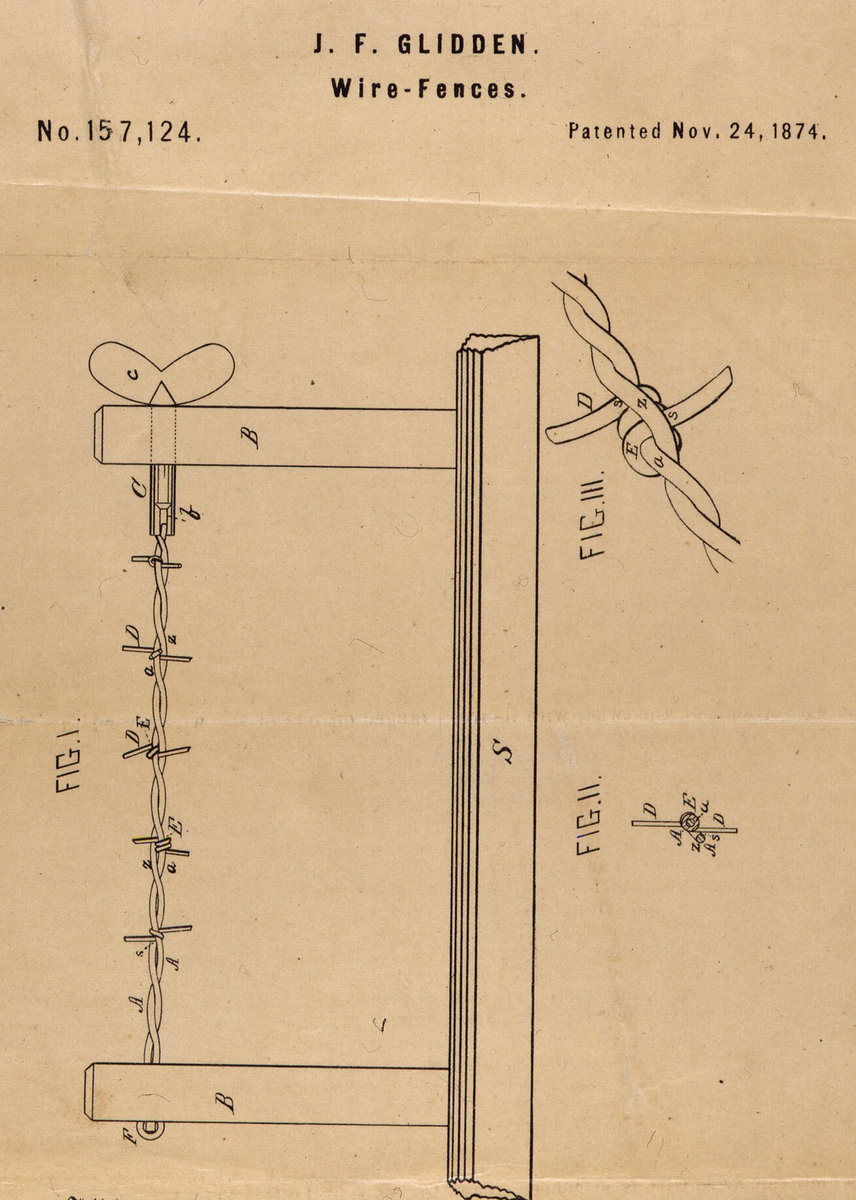 Glidden's patent drawing, dated Nov. 24, 1874. Drawing: U.S. Patent Office (National Archives, NAID 302051) / Wikimedia Commons (public domain, cropped and resized).
A small key through the fence post handled the rest. If the barbs ever worked loose, "a few turns" of the key tightened the twist again and straightened the fence.
That single twist mattered most. Glidden's design locked the barbs in place, and he also built the machinery to make the wire in bulk. It held up against court challenges from rival inventors and outsold them, and people started calling it "the Winner."
From a farm shed to U.S. Steel
Glidden made the first lengths by hand and fenced his own farm with them, so the neighbors could see it worked. In July 1874, he went into business with Ellwood in DeKalb. A single horse powered their first machines. By the winter of 1874-75 they needed a bigger building.
In 1876, Glidden sold his half of the company to Washburn and Moen and kept his royalties. That business grew into American Steel and Wire, which later became part of U.S. Steel.
Collectors now count slightly over 500 patented kinds of barbed wire. The Kansas Barbed Wire Museum alone shows 2,140 unique samples.
Phone calls over the top wire
Barbed wire carried more than fences. Telephone companies spent years skipping farm country, because a mile of rural line served only a couple of customers. So farmers clipped phones to the top wire of their barbed-wire fences and talked to the neighbors. At a road or a gate, they ran the wire up and over on tall posts, about 15 feet (4.6 meters) long and buried about 3 feet (0.9 meters) deep, so the line never broke. These fence lines could connect farmhouses to each other, but not to a town switchboard.
Rural internet still runs into the same problem. The FCC's National Broadband Map shows which providers say they serve your address, what kind of service they offer and their top advertised speeds. Type in your address at broadbandmap.fcc.gov.
If the map is wrong, you can challenge it from the same page. Valid reasons include a provider turning down your request for service, demanding excessive connection fees, or not scheduling an install within 10 business days. The provider has to respond by either conceding or disputing your challenge. For cellphone coverage, the FCC Speed Test app records outdoor tests that count toward a challenge of a carrier's coverage map.
Want more stories like this? Follow Tech Cheat Codes on Facebook. Tap this link, then tap Follow: Follow Tech Cheat Codes on Facebook
Glidden's two twisted wires and one short barb remain the most familiar style of barbed wire. The fence that closed the open range started with a few hairpins missing from a dish on a dresser.
References
- U.S. Patent 157,124, J. F. Glidden, "Improvement in Wire-Fences", U.S. Patent Office, via Google Patents
- Glidden's Patent Application for Barbed Wire, National Archives
- Patent Drawing for Joseph F. Glidden's Improvement to Barbed Wire, NAID 302051, National Archives and Records Administration, via Wikimedia Commons
- Barbed Wire, Joseph F. Glidden Homestead and Historical Center
- Exhibits & Programs, Kansas Barbed Wire Museum
- 'Valiant Servants': Women and Technology on the Canadian Prairies 1910-1940, Manitoba History No. 25, Manitoba Historical Society
- VoBW: Voice over Barbed Wire Fences, Jan Verhelst, Friends of the ATEA Museum
- Broadband Data Collection Consumer Information, Federal Communications Commission