
On this page · 5 sections
The sign on the toilet read: "Sanitized for your safety and health by the crew of STS-106."
A space shuttle crew had left it behind on an earlier visit, and on Thursday, Nov 2, 2000, three men floated past it on their way into history. Sergei Krikalev had just opened the hatch into the Zvezda module of the International Space Station. He turned on the lights as he went. The camera caught the toilet in Zvezda, sign and all.
Monday, Nov 2, is the 26th anniversary of that morning. Someone has lived and worked aboard the station every day since, which adds up to roughly 9,500 days in a row.
Three men and one stubborn hatch
Their Soyuz spacecraft had lifted off from Kazakhstan on Tuesday, Oct 31, 2000, so the trip began on Halloween. Two days later it touched the back of Zvezda at 3:21 a.m. Houston time, which was 4:21 a.m. on the East Coast. Cosmonaut Yuri Gidzenko flew the docking. Bill Shepherd, the NASA astronaut in command, aimed a camera at himself in the cabin during the approach, a shot NASA's history page calls "probably the first selfie of the ISS Program."
Then came the doors. The first one, the hatch on their own spacecraft, gave them "some initial difficulties," in NASA's words. They had spent two days getting there, so a balky hatch was not going to turn them around, and they got it open.
At 4:23 a.m. Houston time, a little over an hour after docking, the last hatch opened. Shepherd, the commander, had asked the two cosmonauts to go first, and he filmed. Krikalev floated through, turning the lights on as he went, with Gidzenko and Shepherd behind him. The two cosmonauts waved at the camera. Then the sign came into view.
Before any work, there was a televised call with a control center outside Moscow, with Mission Control in Houston listening in. The crew spoke briefly with the head of Russia's space agency and NASA's administrator. After that, the first jobs on the list were the hot water dispenser, so they could have a warm drink, and the toilet.
The priorities were clear.
A one-bedroom apartment in orbit
The place they moved into was small. It was three modules, one American and two Russian, with less than 200 cubic meters of pressurized space, roughly a one-bedroom apartment, and about 3 kilowatts of power. By 2015 the station measured 357 feet from end to end and offered more livable room than a six-bedroom house.
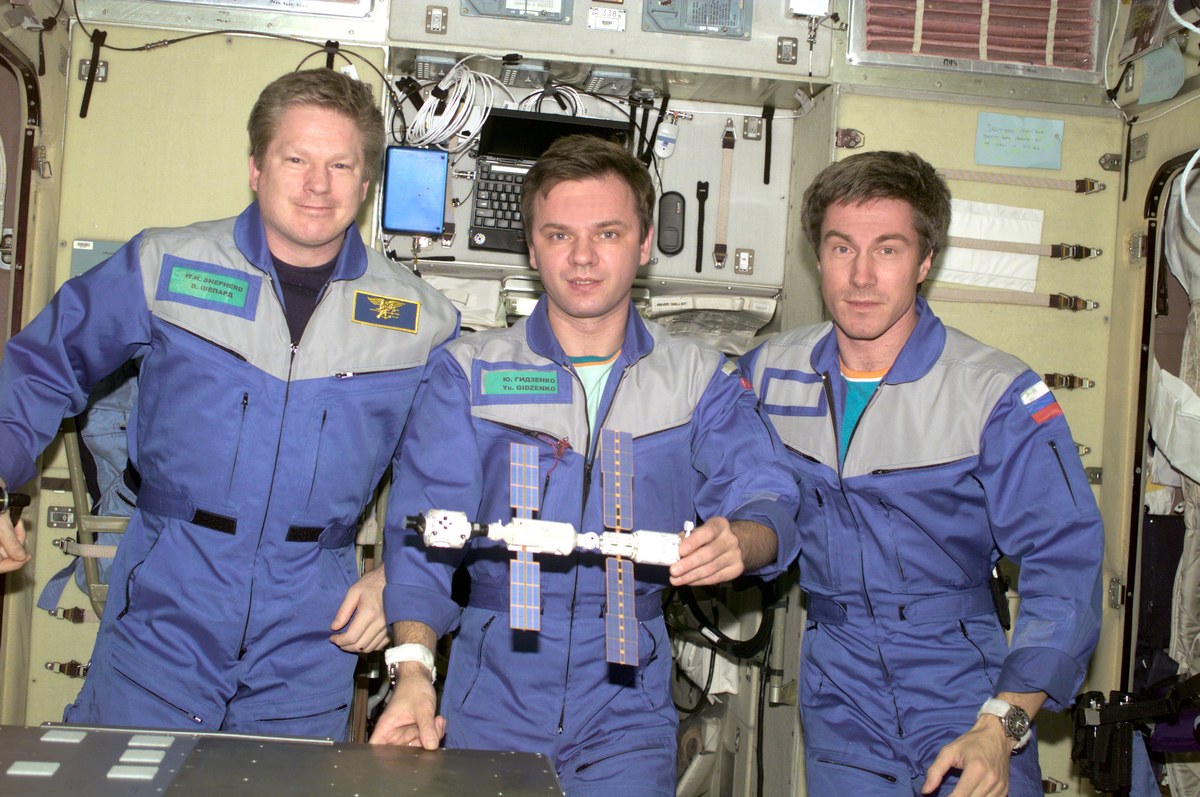 Shepherd, Gidzenko and Krikalev with a model of the station on Dec 24, 2000. Photo: NASA, public domain, via Wikimedia Commons.
Their first weeks went to making the apartment livable. They installed and switched on the systems that make oxygen and scrub carbon dioxide out of the air. In mid-November a Progress cargo ship arrived with more than 5,000 pounds of supplies, water and fuel. Its automatic docking system malfunctioned, and Gidzenko brought it in with a remote-control system instead.
In early December their first houseguests turned up: the crew of the space shuttle Endeavour, who delivered the station's first solar arrays. The photo at the top of this story was taken as Endeavour left, and it is the first picture of the whole station with its new wings open.
Then there was fruit. On Dec 4, the crew gathered in Zvezda for fresh oranges, and somebody snapped them with the fruit hanging in the air in front of them. In weightlessness, an orange stays where you let go of it.
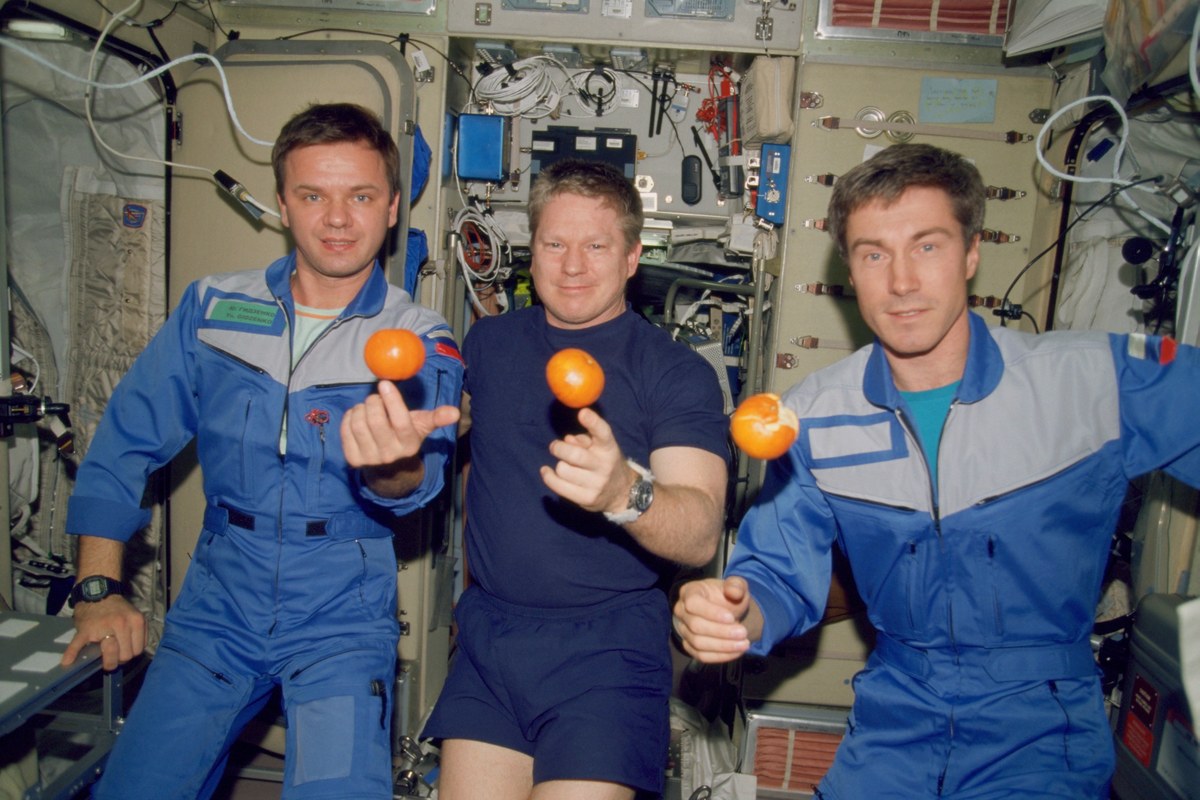 Gidzenko, Shepherd and Krikalev with fresh oranges on Dec 4, 2000. Photo: NASA, public domain, via Wikimedia Commons.
When they had a free minute, they looked out the window. They used hand-held cameras to photograph hurricanes, cities and other features, and on Jan 23, 2001, they caught a plume of ash rising from the Popocatépetl volcano in Mexico.
They also ran about 50 science and technology investigations. One of them started a long line of studies on how spaceflight wakes up viruses that already live in the body, such as the herpes family, without making astronauts sick. Technology designed for that work was patented and led to rapid virus tests used today to diagnose mononucleosis, herpes and chickenpox.
The crew came home on the shuttle Discovery, landing on Wednesday, March 21, 2001, after 141 days. They handed the station to the Expedition 2 crew, and the lights stayed on. Crews have rotated through ever since, and the station has grown from that one-bedroom outpost into the third-brightest object in the sky.
What it means for you
The station is still up there, and you can see it without a telescope. NASA's free Spot the Station app sends alerts when it will pass over your location, and the Spot the Station website lists sightings by city.
Every sighting happens within a few hours of sunrise or sunset. That's when the sky is dark enough, and the station is still lit by the Sun. It looks like a bright star or an airplane moving across the sky, with a few differences. It has no flashing lights, it holds a steady course, and it moves fast. Airplanes fly at about 600 mph, and the station flies at 17,500 mph.
In the app, each sighting lists a time, how long the station stays above the horizon, how high it climbs (0 degrees is the horizon, 90 is straight overhead) and the compass directions where it appears and disappears. Look toward the first direction a minute early.
Pick one evening this week and make it a small event with a grandchild, a neighbor or a parent who has never done it. The station's orbit is tilted 51.6 degrees from the equator, so in places farther north than that, Alaska included, it doesn't pass straight overhead, and the app may not show every pass.
The man who opened the door
Krikalev had been through this before, in a very different way. In May 1991 he lifted off for the Soviet space station Mir, a cosmonaut of the Soviet Union. While he was up there, the Soviet Union came apart. Some people started calling him "the cosmonaut without a country."
He came down in Kazakhstan on March 25, 1992, after 312 days in orbit, in a country that was entirely different from the one he had left. His uniform sleeve still carried the letters "U.S.S.R." and the red Soviet flag.
He kept flying. In 1994 he became the first cosmonaut to fly on an American space shuttle. In December 1998 he flew on Endeavour for the first station assembly mission.
Two years later, he opened the last hatch into the station and turned on the lights.
References
- Source: John Uri, NASA, "Space Station 20th: Expedition 1 Arrives at the International Space Station!," Nov 2, 2020
- Source: NASA, "Looking Back: International Space Station at the Start of Expedition 1," Nov 2, 2015
- Source: NASA Space Station Research Integration Office, "Expedition 1 Kicks Off Science Aboard International Space Station," Jul 24, 2022
- Source: NASA, "Expedition 1" mission page (launch Oct 31, 2000; landing Mar 21, 2001)
- Source: NASA, Spot the Station (alerts, speeds, orbit tilt, third-brightest object)
- Source: Los Angeles Times, "After 10 Months in Space, Cosmonaut Is in a New Land," Mar 26, 1992
- Source: UPI, "Russian cosmonauts return to different country," Mar 25, 1992
- Source: NASA History, "STS-60: A Cosmonaut Flies on the Shuttle" (Krikalev biography)