
On this page · 5 sections
On election night in 1920, Pittsburgh residents stood in cold, rainy streets waiting for newspaper offices to post the results on a bulletin board. A few of their neighbors were already home and warm, and they knew who had won. They had heard it through a pair of headphones, from a microphone that looked like a tomato can.
The can was real, or close to it. The Smithsonian, which owns the actual microphone, describes it as a "brass can painted black, wire gauze at one end." Harold Arlin, a young Westinghouse engineer who visited the rooftop studio in 1920, remembered it the same way: "It looked like a tomato can with a felt lining. We called it a mushophone."
On Tuesday, Nov 2, 1920, it carried the vote count from a shack on a factory roof in East Pittsburgh to anyone who owned a receiver. Monday, Nov 2, marks 106 years since that night, and this year's Election Day is the next day, Tuesday, Nov 3.
A phonograph and a record store
Radio had a rough start in the United States. During World War I, the government ordered nearly all privately owned stations dismantled so nobody could use them for spying. When the war ended, thousands of young men who had learned radio in the Signal Corps came home knowing how to build and run the equipment. Before that, a big news night meant standing outside a newspaper office and waiting for someone to chalk up the score.
The broadcast story starts a year earlier with a Westinghouse engineer named Frank Conrad, who ran a ham radio station and had one big advantage over other hobbyists: easy access to the company's vacuum tubes. To test his transmitter, he borrowed the family phonograph as a sound source and walked away to listen.
Other hams heard the music and wrote in, often asking for specific records. Conrad got tired of filling requests one at a time and began airing a regular "concert." A local music store started giving him new records in exchange for on-air plugs. Free records for a mention: the arrangement sounds familiar, and radio was still a hobby.
By the fall of 1919, his shows drew an estimated 400 to 500 listeners. A Pittsburgh newspaper noticed. A department store began selling cheap receivers so people could hear him. A Westinghouse vice president, Harry P. Davis, noticed the store ad and saw a bigger idea than a hobby. He later wrote that radio could be "the greatest and most direct means of mass communication and mass education that had ever appeared."
Davis put a 100-watt transmitter in a small shack on the roof of one of the company's buildings. On Wednesday, Oct 27, 1920, the Department of Commerce issued the station its license, with the call letters KDKA. The letters don't stand for anything. They were simply the next set on a list that had been used for ships.
Now the station needed something worth hearing. The presidential election was six days away.
A rooftop crew, one phone line and a backup plan
Davis arranged for the Pittsburgh Post to phone the vote totals to the transmitter room, which doubled as the studio. Leo Rosenberg, from the company's publicity department, would read them on the air. Donald Little, who had helped Conrad build the transmitter, served as chief engineer. William Thomas held the radio license needed to run it. John Frazier handled the phone line, and R.S. McClelland stood by.
That was the crew on the roof, and one more man was miles away. Worried that the new equipment might fail, Conrad waited at his own station in Wilkinsburg, ready to carry on if KDKA went dark.
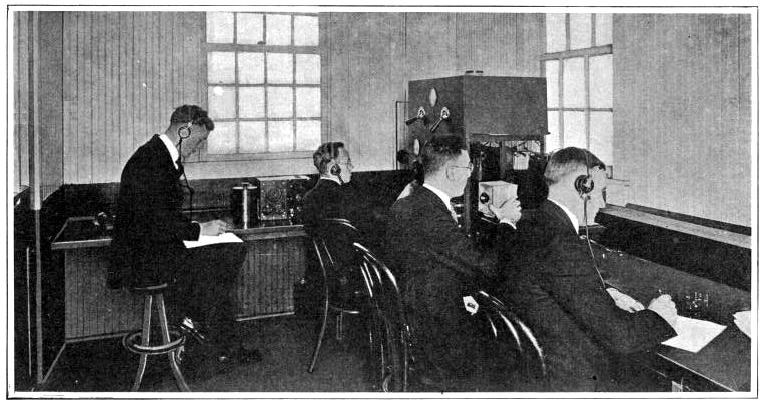 A KDKA transmitting room around 1921, soon after the election broadcast. Photo: Austin C. Lescarboura, public domain, via Wikimedia Commons.
Rosenberg opened with a request that sounds odd now: "We'd appreciate it if anyone hearing this broadcast would communicate with us, as we are very anxious to know how far the broadcast is reaching and how it is being received."
Between returns, a wind-up phonograph played records, and local banjo players performed live. The announcer talked, the phone rang and the next batch of numbers came in. There were no reported technical problems.
Then the mail arrived. Some of it came from amateurs who had shared their headphones with neighbors. Some came from a party at the Edgewood Club just outside the city, where Westinghouse had set up a receiver and a loudspeaker and advertised the evening in advance. As Little recalled it, a Westinghouse engineer there, Lewis Chubb, phoned the station with a review: the audience wanted less music and more election returns.
One of radio's earliest audience reviews was in, and the audience wanted the news.
Nobody counted the audience, and the accounts disagree on the details. Estimates run from fewer than 1,000 listeners to about 2,000. The start time is given as 6 p.m. in some tellings and 8 p.m. in Little's memory. Harding won in a landslide.
Radio spread fast. Within two years, more than 500 licensed stations were broadcasting across the country.
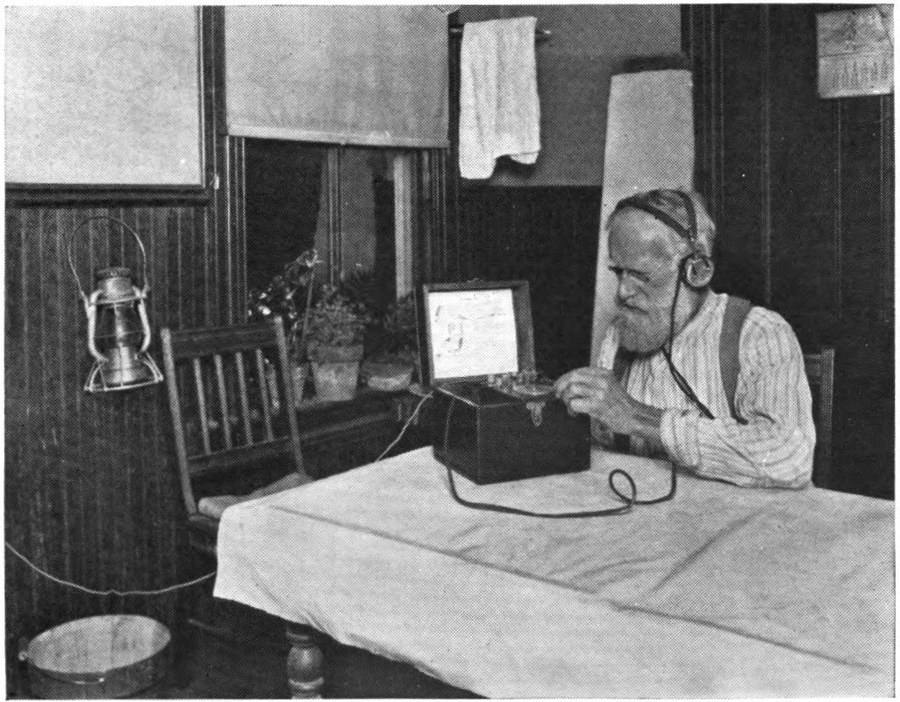 A man listening on a crystal radio set, around 1922, from "The Complete Radio Book." Photo: unknown author, public domain, via Wikimedia Commons.
What it means for you
Radio can still do what it did that night. It reaches you without the internet, without a phone signal and often without a plug. A radio with batteries or a hand crank works when the power is out.
Ready.gov lists a "battery-powered or hand crank radio and a NOAA Weather Radio with tone alert" in its basic emergency supply kit. If you have a relative who lives alone, a parent or a neighbor who doesn't use a smartphone, this is an easy gift. Put in fresh batteries, set it on a shelf, and show them where the switch is.
The other lesson from 1920 is that early numbers are not final. Election night results can shift as counties finish counting, and state election offices certify the final results. For Tuesday, Nov 3, bookmark your state election office's website, and check there for the official numbers.
The skipper who didn't buy it
One more story from that night, as it was told in a 1963 history of radio. It comes from a book written decades later, not from a record of the time, so treat it as lore.
A radio operator on a ship off the coast of Virginia, carrying American troops from Puerto Rico to New York, heard the broadcast in his earphones. Excited, he hurried to his captain, expecting the returns to be posted on the ship's bulletin board.
The captain refused. He had once been the victim of an early radio hoax, and he was suspicious. He would not let the bulletins go up.
So on election night 1920, the night radio changed how the news traveled, one ship's bulletin board stayed blank.
References
- Source: Pennsylvania Center for the Book, Penn State University Libraries, "KDKA: Broadcasting's Pioneer Station"
- Source: James E. O'Neal, Radio Heritage Foundation, "Radio Broadcasting Becomes a Reality: KDKA on Nov. 2, 1920," Nov 4, 2020 (quotes Little, American Heritage, 1955; Davis, "American Beginnings," 1930)
- Source: Smithsonian National Museum of American History, "Westinghouse 'Tomato Can' microphone from station KDKA" (EM.311444)
- Source: Baseball Hall of Fame, "Radio Days" (Harold Arlin quote on the microphone)
- Source: CBS Pittsburgh, "KDKA's Historic Broadcast" (call letters, crew, license date, audience estimate)
- Source: Pittsburgh Magazine, "Why the National Museum of Broadcasting Will Call Pittsburgh Home" (wind-up phonograph, banjo players, 100-watt transmitter)
- Source: Pennsylvania Heritage Magazine, "Live From Pittsburgh" (rainy streets, Conrad's standby at 8XK, Edgewood Club)
- Source: Pateplumaradio.com, "The 1924 Radio Election" (Edgewood Club, estimate of about 2,000 listeners, 8 p.m. start)
- Source: Robert Feder, Daily Herald, "Election night coverage marks radio's 100th anniversary," Nov 3, 2020 (Rosenberg's words; more than 500 licensed stations within two years)
- Source: Slate, "It Sounds Impossible" (1963 book; ship story)
- Source: Ready.gov, "Build a Kit" (battery-powered or hand crank radio, NOAA Weather Radio)
- Source: Federal Election Commission, "Election results and voting information" (state election offices certify results)