
On this page · 5 sections
Sixty-nine years ago today, a small stray dog from the streets of Moscow became the first living creature to circle the Earth. Her name meant Barker. She did not come home.
On Sunday, Nov 3, 1957, less than a month after Sputnik 1 beeped its way into history, the Soviet Union launched Sputnik 2 from what is now Baikonur. The second satellite weighed about 1,120 pounds, more than six times the first one, and it carried a passenger: a mixed-breed street dog the trainers called Kudryavka, "Little Curly." The world learned her as Laika. American newspapers, not shy about a nickname, soon called her Muttnik.
Today is Tuesday, Nov 3, 2026. Laika's flight turns 69.
A rush job with a living passenger
Sputnik 1 had stunned the world on Oct 4. Soviet leader Nikita Khrushchev wanted another bold launch in time for the 40th anniversary of the Bolshevik Revolution, only about a month away. Chief designer Sergei Korolev's team built Sputnik 2 in a hurry, often without the usual drawings and checks. Korolev told his team there would be no special drawings and no quality checks; everyone would be guided by his own conscience.
The new craft had a pressurized cabin for an animal, oxygen gear, a carbon dioxide scrubber, and a fan that switched on when the cabin got warmer than about 59°F. Food came as a jelly. Sensors tracked heart rate, breathing, blood pressure and movement. There was no plan to bring the passenger back. The technology to return a living creature from orbit simply wasn't ready yet, and the schedule would not wait.
Soviet biomedicine had already been flying dogs on shorter rocket hops through the early 1950s. The first canine pair, Dezik and Tsygan, flew and came back in August 1951. Not every early flight ended that well. Dogs beat monkeys for these tests: they stayed calmer in a tight cabin, and female strays were easier to fit with waste gear. Trainers kept candidates in smaller and smaller cages for days, then weeks, and got them used to loud noise and shifting air pressure. Some dogs hated the sanitation harnesses so much they held their waste even after laxatives. The ones who adapted stayed in the program.
Three dogs made the final cut for Sputnik 2. Albina was the backup, and she had already flown on high-altitude rockets. Mushka tested the instrumentation and life support. Laika got the seat that would not return.
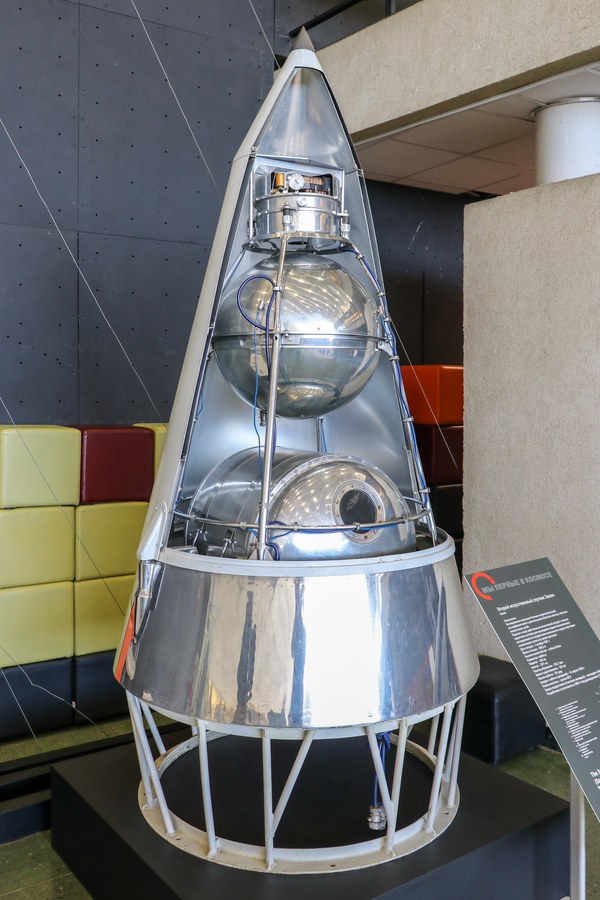 A replica of Sputnik 2 at the K. E. Tsiolkovsky Museum of the History of Cosmonautics in Russia, with a cutaway showing the sphere and the pressurized cabin below. Photo: Stolbovsky, CC BY 4.0, via Wikimedia Commons.
A street dog, a harness and a one-way ticket
Laika was about three years old, a small mongrel picked up from Moscow's streets. Street dogs already knew cold, hunger and noise, which the trainers treated as a rough kind of screening. Before the flight, one of the physicians, Vladimir Yazdovsky, took her home for a short visit. He later explained that he simply wanted to do something nice for the dog. It is one of the few soft details in a hard story, and it has stuck with people for decades.
Three days before launch she entered the cramped travel cabin, with only a few inches to move, sensors on her body, and a harness that held her in place. Early on the morning of Nov 3, around 5:30 a.m. Moscow time, the R-7 rocket lifted off. During the climb her heart rate roughly tripled from its resting level, and her breathing climbed several times above normal. She reached orbit alive. The cabin circled the Earth about once every 103 minutes.
Then the heat rose.
Telemetry later showed that after the first few orbits, cabin temperature and humidity climbed sharply. By roughly five to seven hours into the flight, no more life signs were coming back. By the fourth orbit, Laika was gone. The likely culprit was a thermal-control failure tied to the rushed design; the booster core did not separate the way planners wanted, and the cabin overheated.
For years, official stories claimed she lasted days, or that she was put to sleep before her oxygen ran out. Soviet broadcasts kept the fiction going while Sputnik 2 was still beeping. In 2002, Dimitri Malashenkov, one of the scientists on the project, told a space congress in Houston the harder truth: she died from overheating and stress within hours.
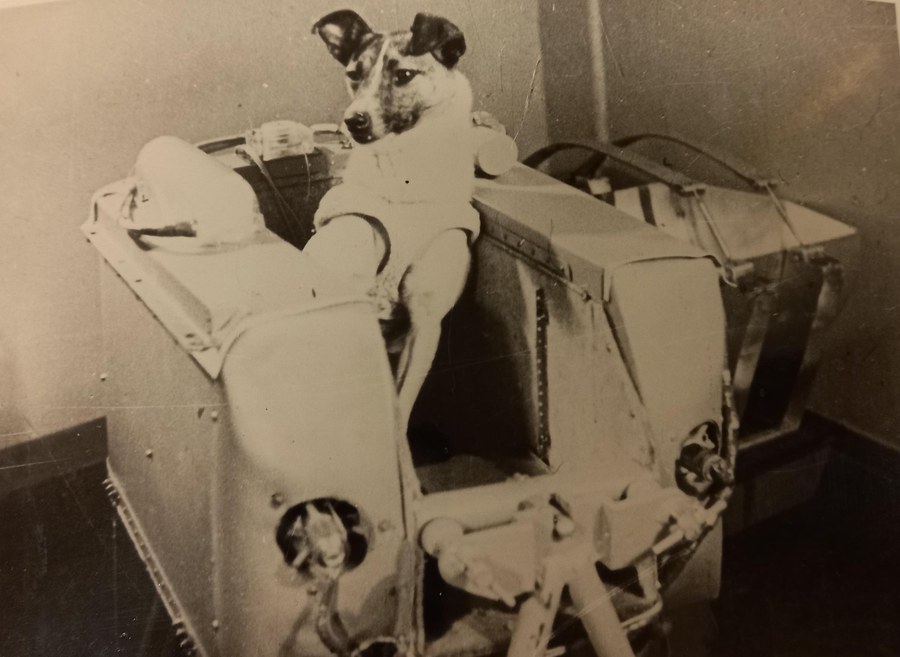 Laika in a training cabin before the Sputnik 2 flight. Photo: unknown author, public domain, via Wikimedia Commons (State Historical Museum catalog).
What it means for you
Laika's flight answered a question nobody could settle on the ground: could a living body survive the climb to orbit and a stretch of weightlessness? The answer, short as her time was, helped clear the path for the first human flights a few years later. Future U.S. manned-space leaders took the point immediately. When Robert Gilruth, who later ran the center that trained American astronauts, saw the dog go up, he told historians the country had better get moving, because putting people in space was about to become a real program.
It also left a permanent mark on how people think about the cost of that path. Protesters walked dogs outside the United Nations. Animal-welfare groups in Britain objected. A lot of ordinary readers, then and now, can hold two thoughts at once: the flight mattered for human space travel, and the passenger deserved better than a one-way box.
You can still watch the descendants of that era pass over your own town. People have lived aboard the International Space Station for 26 years now, and the station is bright enough to see with the naked eye on the right pass. NASA's free Spot the Station tool texts or emails you when a visible pass is coming, with the time, direction and how high it will climb. Sign up once at spotthestation.nasa.gov, or through the page linked below, then step outside on a clear night and look where the alert points. Give your eyes a minute away from porch lights. No telescope required. If you miss one pass, another usually comes within a few days.
That bright moving "star" is the long echo of a program that started with a street dog who did not get a return ticket.
The apology that came decades late
Sputnik 2's batteries died around Nov 10, and the science signals stopped with them. The silent craft kept orbiting until it burned up on reentry on April 14, 1958, after months alone and more than 2,500 trips around the Earth. Nearly three years later, other Soviet dogs, Belka and Strelka, flew and came home alive, proof that the return problem could be solved when the schedule allowed it. Strelka later had puppies; one of them even ended up as a gift for the Kennedy family. In 2008, Moscow unveiled a monument to Laika near the military research facility that prepared her flight: a dog standing atop a rocket.
The line that stays with me is not from 1957. It came decades later from Oleg Gazenko, one of the scientists who worked with the space dogs:
"The more time passes, the more I'm sorry about it. We shouldn't have done it. We did not learn enough from this mission to justify the death of the dog."
A stray who barked for a radio audience, who spent one quiet evening in a doctor's home, who rode a rushed machine into the dark, and who is still the reason a lot of us look up when a bright station slides across the sky.
Today's cheat code: see the space station from your backyard with NASA Spot the Station — How to see the ISS this week.
Enjoyed this? Follow Tech Cheat Codes on TikTok for quick tech tips: Follow on TikTok. Or open TikTok and search "Tech Cheat Codes".
References
- Source: NASA History, John Uri, "60 years ago: The First Animal in Orbit," Nov 6, 2017 (Nov 3, 1957 launch; Laika first animal in orbit; ~508 kg; no recovery; survived a few hours; batteries Nov 10; reentry April 14, 1958; later safe animal returns)
- Source: NASA History, "65 Years Ago: Sputnik Ushers in the Space Age" (Sputnik 2 ~1,121 lb vs Sputnik 1 ~184 lb; no recovery system; short survival; batteries Nov 10; reentry April 14, 1958)
- Source: NASA History, Tara Gray, "A Brief History of Animals in Space," 1998 (dogs chosen over monkeys; females; Laika = Husky/Barker; Kudryavka = Little Curly; Muttnik; stray mongrel; expired after a few hours; burned up April 1958)
- Source: NASA History, James Harford on Korolev (Khrushchev request for a Revolution-anniversary launch; ~one month build; 508 kg; Laika; overheating after booster separation issue)
- Source: BBC News Online, David Whitehouse, "First dog in space died within hours," Oct 28, 2002 (Malashenkov at World Space Congress; jelly food; chained; CO2 absorber and oxygen generator; fan above 15°C; Albina/Mushka; pulse triple; 5–7 hours; fourth orbit; prior claims of days/week)
- Source: Smithsonian Magazine, Alice George, "The Sad, Sad Story of Laika, the Space Dog," April 11, 2018 (Khrushchev timing; ~1,120 lb; Yazdovsky home visit; three days in cabin; Nov 3 ~5:30 a.m. lift-off; heartbeat triple; breath up; ~103-minute orbit; heat; Gazenko regret line; Belka and Strelka later)
- Source: Radio Free Europe/Radio Liberty, "Laika The Space Dog" (2008 Moscow monument; Gazenko regret quote)
- Source: Tech Cheat Codes, "How to See the Space Station From Your Backyard This Week" (NASA Spot the Station; 26 years of ISS crews)