On this page · 6 sections
On Monday, Oct. 31, 1938, Trenton, New Jersey, City Manager Paul Morton sent a letter on city letterhead to the Federal Communications Commission. He wrote that a radio play the night before had "completely crippled" the police department's communication facilities for about three hours. He wrote that two thousand phone calls came in within about two hours, along with long-distance calls from many states asking about relatives and families thought to have been killed. He asked the FCC to investigate and prevent a repeat. Those numbers are his own statement, and the other sources cited here don't confirm them.
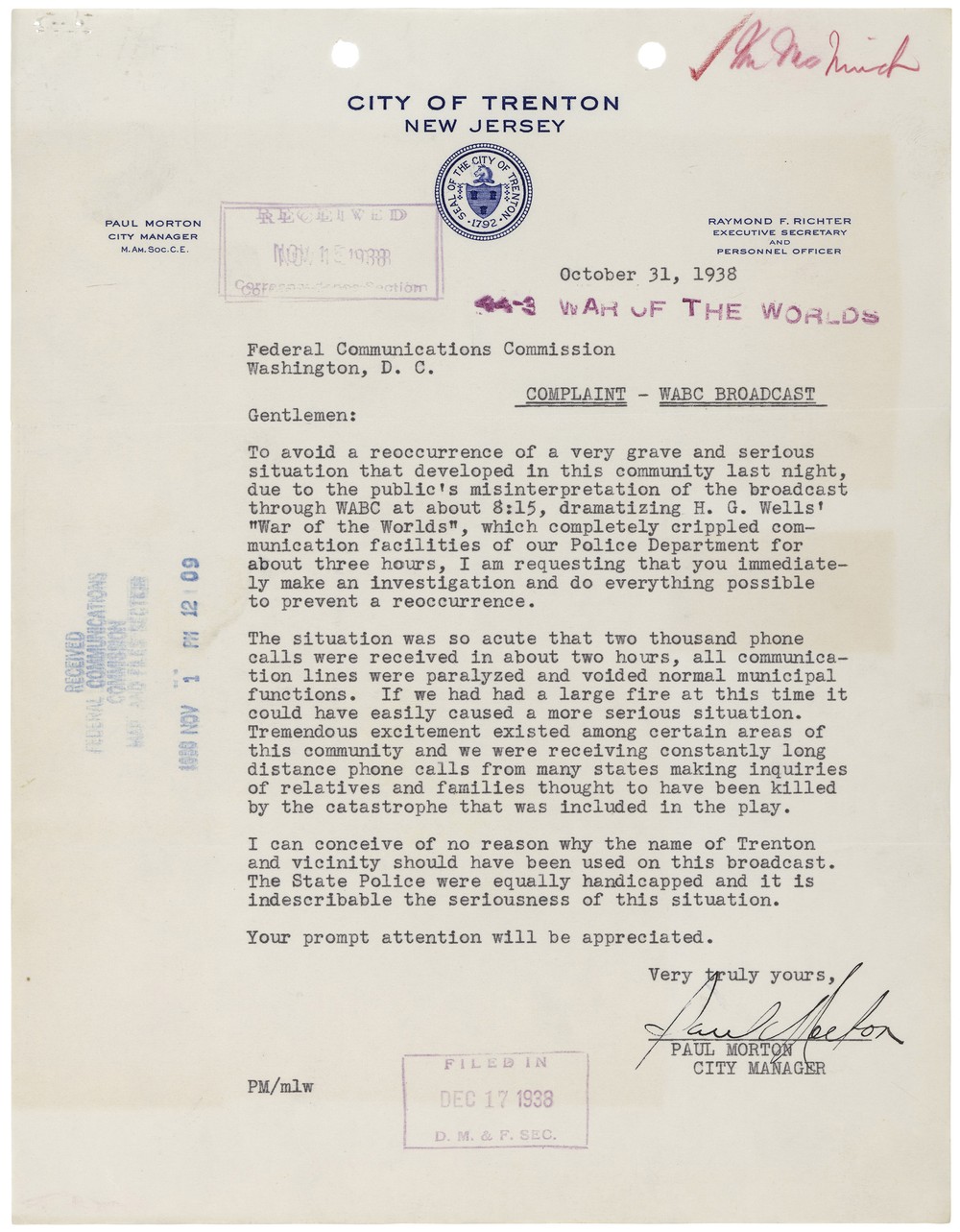 Trenton City Manager Paul Morton's letter to the FCC, dated Oct. 31, 1938. Scan: U.S. National Archives, no known copyright restrictions, via Wikimedia Commons.
The play was Orson Welles's "The War of the Worlds," a radio drama staged as fake news bulletins about Martians landing in New Jersey. A second letter to the same agency, dated Nov. 1, came from an official in Aberdeen, South Dakota. J. V. Yaukey had heard the same show and "sat serenely entertained no end by the fine portrayal of a fine play." He guessed the FCC had already heard from "numerous cranks and crack-pots."
Both letters sit in the FCC's files at the National Archives. How far the country matched either letter is something researchers have argued about for decades.
What this means for you
A scary story that moves fast often starts with a small number of loud, real events. By Pooley and Socolow's account, newspapers turned one night of phone calls into a national panic by the next morning. Before you believe or pass along a viral scare today, take as little as 30 seconds: pause, check who published it, look for other coverage, and trace the claim to where it began.
How the show came to sound real
The Mercury Theatre on the Air was a CBS series with no sponsor, 17 weeks old that week. A. Brad Schwartz writes that no one on the team expected the Martian episode to fool anyone. Writer Howard Koch told producer John Houseman on Tuesday, Oct. 25, that the script was hopeless. Houseman lied and said Welles was determined to do it anyway. A bare-bones rehearsal that Thursday, with no music and only the most basic sound effects, was an unmitigated disaster, and those who heard it later agreed.
The rewrites then made it more convincing without anyone meaning to, Schwartz writes. Some mentions of time passing were cut, so the invasion seemed to unfold live. Welles slowed the opening to a crawl so the speed-up would feel natural. The station break landed about two-thirds of the way through instead of at the halfway mark, so a listener who tuned in late and missed the opening announcements would wait almost 40 minutes for word that it was fiction. Breaking news doesn't follow station-break rules, and Schwartz writes that listeners who believed the show was real would be even more convinced when no break came at 8:30 p.m. Welles later claimed the team had hoped to fool some listeners. Houseman and Koch denied it.
Some listeners did take it for news. Their worried calls to police, newspaper offices and radio stations convinced many journalists that the country was in a panic.
How a few calls became a front page
The next morning Welles's name was on front pages coast to coast. Researchers Jefferson Pooley and Michael Socolow argue the papers had a motive. Radio had pulled advertising money away from print during the Depression, and a panic story made radio look reckless. The New York Times ran an editorial titled "Terror by Radio." Ben Gross, radio editor of the New York Daily News, later recalled Manhattan's streets as deserted while his taxi raced to CBS that night, and the Daily News still splashed the panic across its cover.
Then the checking started, and it didn't turn up much. Pooley and Socolow write that no newspaper reported a verified suicide tied to the broadcast. A Washington Post story about a Baltimore listener's fatal heart attack went unconfirmed. Researchers in Princeton's radio research office checked a rumor that people were treated for shock at a Newark hospital and found it was wrong. Six weeks later they surveyed six New York City hospitals, and none had a record of a patient brought in because of the show. A Washington Post reader who walked down F Street during the broadcast wrote that he saw "nothing approximating mass hysteria." W. Joseph Campbell, who studied the coverage, found most papers dropped the story within a day or two.
The government barely reacted. The FCC's chairman got the networks to agree informally to stop using fake news flashes in dramas. Neither CBS nor Welles was sanctioned.
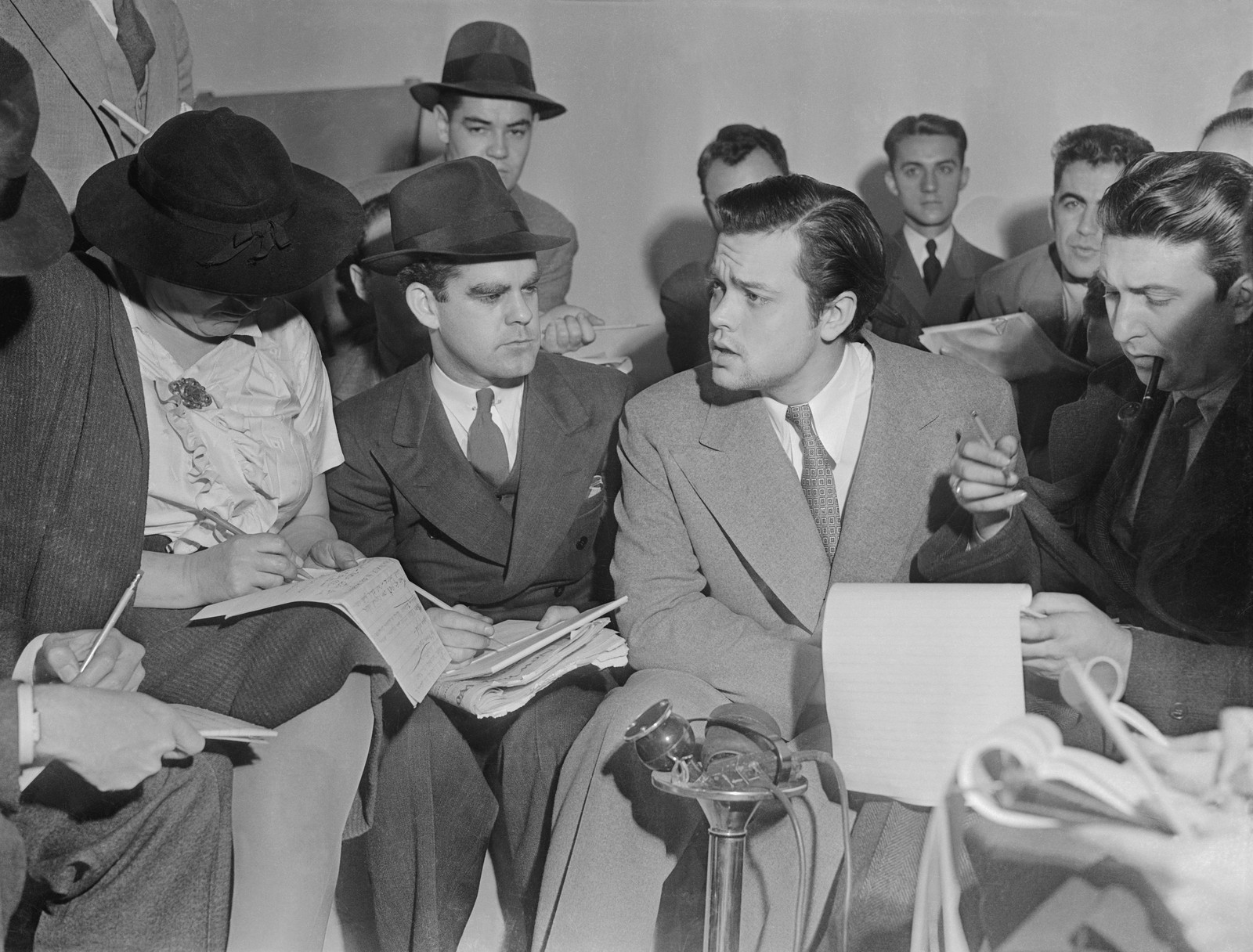 Welles met reporters the day after the show. Photo: Acme News Photos, public domain, via Wikimedia Commons.
How many people were scared
The sources don't give a clean number, and the available ones disagree.
The C.E. Hooper ratings service phoned 5,000 households that night. Only 2 percent named the Welles program, and none called it a news broadcast. Welles was up against ventriloquist Edgar Bergen's comedy hour, and some CBS affiliates, including Boston's WEEI, ran local programs instead. CBS ran its own survey the next day. Frank Stanton, an executive there, later recalled that "most people didn't hear it" and that those who did took it as "a prank." Pooley and Socolow add that the claim of millions of listeners twirling their dials over to Welles has no number behind it.
Hadley Cantril, a Princeton psychologist, put out the other estimate in his 1940 book The Invasion from Mars. He wrote that at least six million people heard the broadcast and at least a million were frightened or disturbed. His figures lean on a poll taken about six weeks after the show. In it, 28 percent of listeners said they took the broadcast for news, and 70 percent of those said they were frightened or disturbed. He worked that out to about 1.7 million and 1.2 million people. Cantril noted that the poll's audience figure was "over 100 per cent higher" than any other known measure, though he judged it probably the most accurate because it reached small towns and homes without phones. He also allowed that some people may have said they heard the show only because they had heard so much about it. He also thought people ashamed of being fooled might have kept quiet, which made the fright number "probably the very minimum."
Pooley and Socolow also dispute the word "panic." In the 1930s, radio audiences were often frightened or excited by suspense dramas, they write, and that's different from running into the street. Schwartz, who studied the production's script drafts, describes a fraction of the audience being convinced. He doesn't put a number on it.
Schwartz writes that some listeners mistook the bulletins for real news and called the police, and Pooley and Socolow grant that the small audience was excited.
The quick check, run on this story
Try the four moves on the legend. They come from a method called SIFT, built by Mike Caulfield at Washington State University Vancouver.
Stop. A front page that says a whole country panicked over a radio play is built to make you react. Slow down.
Investigate the source. Ask what the source gets out of the story. Pooley and Socolow argue the newspapers of 1938 had a business reason to make radio look dangerous.
Find better coverage. The Hooper numbers, the hospital checks and the Washington Post reader are other accounts of the same night, and they point a different way from the headlines.
Trace it back. Go to the original document. The FCC letters are scanned and free to read, and the two of them don't agree.
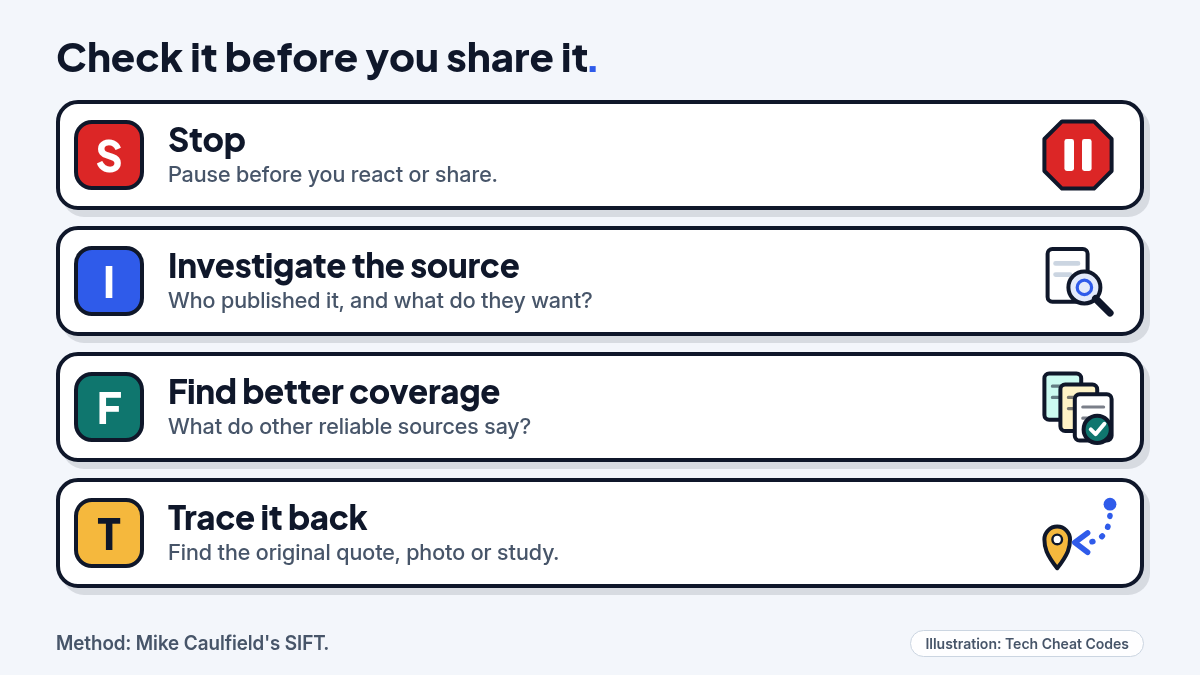 The four SIFT moves. Illustration: Tech Cheat Codes.
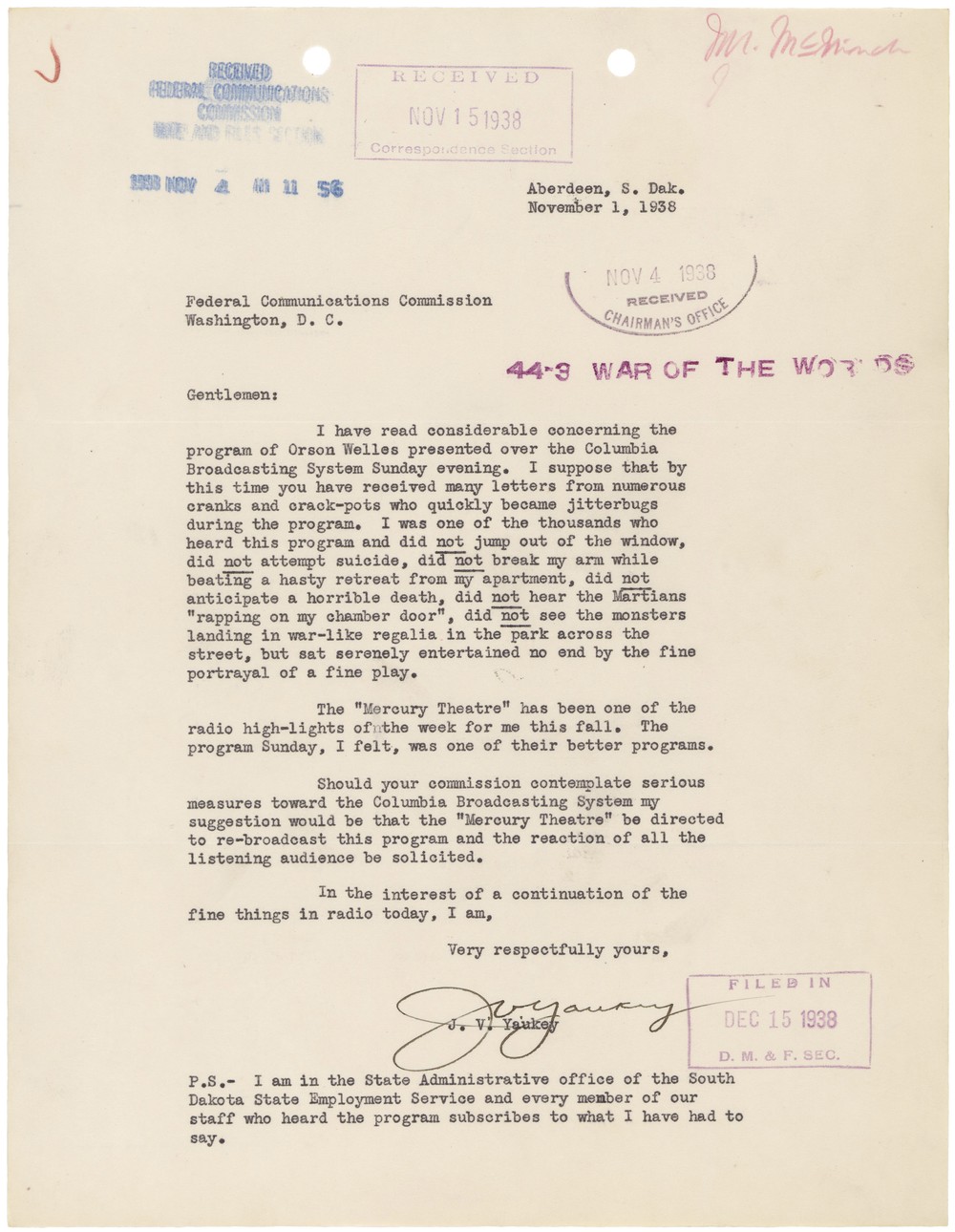 J. V. Yaukey's Nov. 1, 1938 letter from Aberdeen, South Dakota. Scan: U.S. National Archives, no known copyright restrictions, via Wikimedia Commons.
Yaukey's letter is a good one to keep in mind. He underlined the "not" in each item on a list of things he didn't do that night, which included jumping out a window and seeing the monsters land in the park across the street. He was an official in a state employment office, and his postscript says every member of his staff who heard the show agreed with him. That's one office, in one town. It isn't a poll. It's still an account from someone who was there.
References
- Source: Jefferson Pooley and Michael J. Socolow, "The Myth of the War of the Worlds Panic," Slate (Oct. 28, 2013)
- Source: A. Brad Schwartz, "The Infamous 'War of the Worlds' Radio Broadcast Was a Magnificent Fluke," Smithsonian Magazine (May 6, 2015)
- Source: Hadley Cantril, The Invasion from Mars: A Study in the Psychology of Panic (Princeton University Press, 1940), chapter II, via the Internet Archive
- Source: Paul Morton to the Federal Communications Commission, Oct. 31, 1938 (FCC General Correspondence, U.S. National Archives, via Wikimedia Commons)
- Source: J. V. Yaukey to the Federal Communications Commission, Nov. 1, 1938 (FCC General Correspondence, U.S. National Archives, via Wikimedia Commons)
- Source: Mike Caulfield, "SIFT (The Four Moves)," Hapgood (June 19, 2019)
- Source: Washington State University, "Detect coronavirus misinformation in 30 seconds," WSU Insider (Feb. 27, 2020)
- Source: Acme News Photos, "Orson Welles War of the Worlds 1938.jpg," Wikimedia Commons (Oct. 31, 1938, public domain)


