
On this page · 2 sections
One hundred thirty-one years ago today, on the evening of Nov 8, 1895, Wilhelm Conrad Röntgen stood in a darkened physics lab in Würzburg with a cathode tube wrapped so tight in thick black carton that no visible light could leak. He switched on the discharge. Across the room — as far as two meters in later checks — a paper screen coated with barium platinocyanide lit up apple-green anyway.
That should not have happened. Cathode rays, as everyone understood them, did not travel that far through air. Something else was coming out of the tube. Röntgen moved books, wood, and lead between the carton and the screen. Soft things barely dimmed the glow. A thin lead sheet stopped it cold. He did not know what the rays were, so he named them the way an algebraist names a blank: X-rays.
Weeks of nights, then a plate
He barely left the institute for the next six weeks, working almost alone and telling almost no one what he had found. He tested photographic plates through their paper wrappers. He watched shadows of metal weights and of his own hand on the fluorescent board. Bones showed up as darker strokes than flesh.
The famous radiograph was not that November night. On Dec 22, 1895 — six weeks after the glowing screen — he asked Bertha to hold her left hand still over a photographic plate while the tube ran. When the plate developed, her finger bones stood out as dark shadows inside the fainter flesh, and on one finger sat the black oval of her wedding ring.
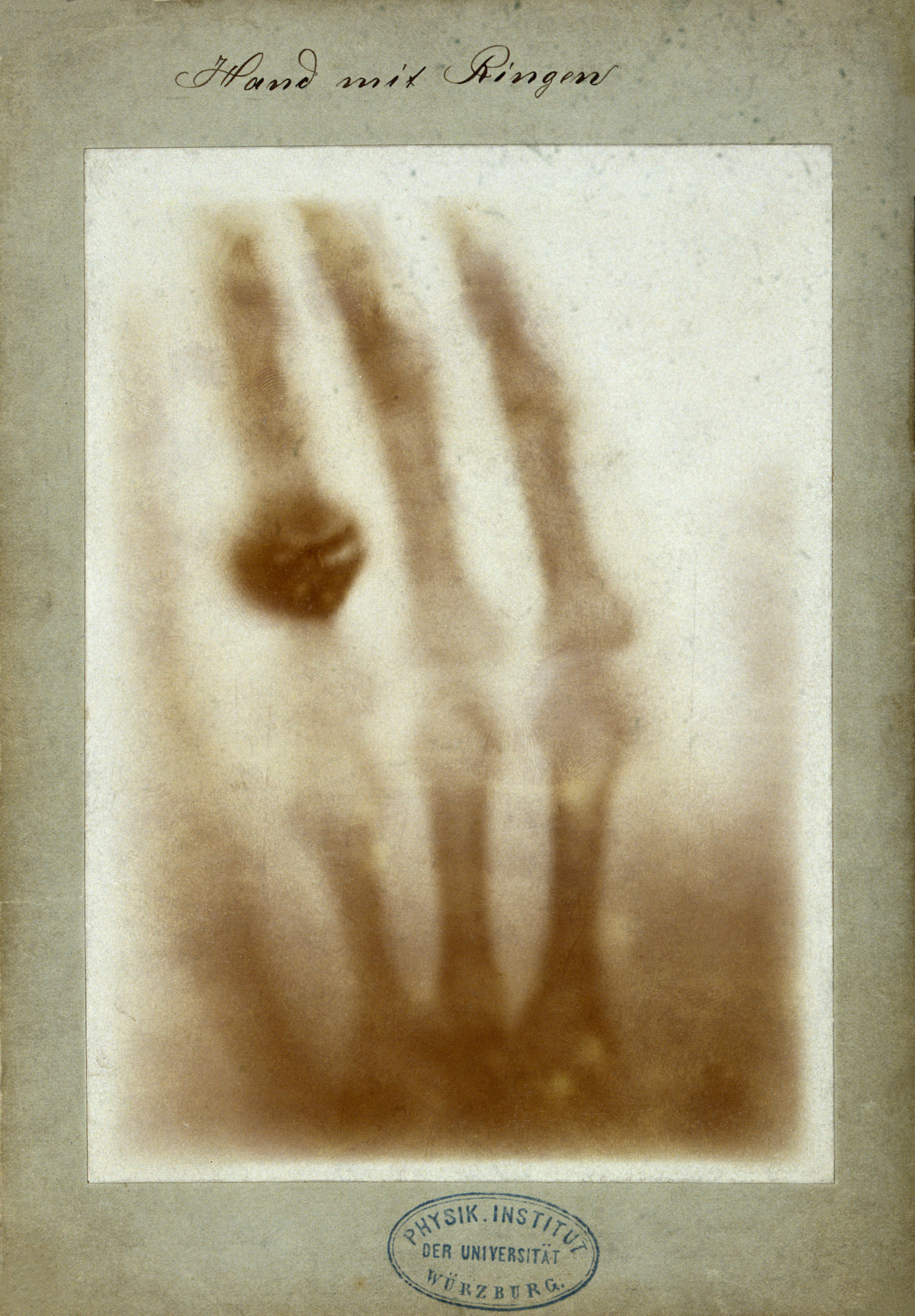 Hand mit Ringen — Anna Bertha Röntgen's left hand, Dec 22, 1895. Wilhelm Röntgen (public domain), via Wikimedia Commons.
Six days later he handed the Würzburg Physical-Medical Society a short paper titled Über eine neue Art von Strahlen — On a New Kind of Rays. By early 1896 clinics were already making bone portraits.
The line that has come down with the image is Bertha's — she had seen her own death. He took no patent on the rays. In 1901 he collected the first Nobel Prize in Physics.
Enjoyed this? Follow Tech Cheat Codes on TikTok for quick tech tips: Follow on TikTok. Or open TikTok and search "Tech Cheat Codes".
References
- Source: Nobel Prize Organization, Wilhelm Conrad Röntgen – Biographical (Nov 8, 1895 evening; sealed thick black carton; barium platinocyanide screen fluorescent to ~2 m; named X-rays; wife's hand radiograph with bones and ring; first Nobel Physics 1901)
- Source: Guinness World Records, "First x-ray" (Anna Bertha left hand with wedding ring dated 22 Dec 1895, University of Würzburg; discovery 8 Nov 1895; Nobel Physics 1901)
- Source: Röntgen Memorial Würzburg (wilhelmconradroentgen.de), Wilhelm Röntgen (discovery 8 Nov 1895 Physical Institute Würzburg; Bertha hand Dec 1895; public lecture 23 Jan 1896; refused patent; Nobel 10 Dec 1901, prize money to Würzburg)
- Source: American Physical Society News, "November 8, 1895: Roentgen's Discovery of X-Rays" (Crookes tube; black cardboard; screen ~nine feet; paper "On a New Kind of Rays" Dec 28; no patents; Nobel 1901) — NOTE: APS wrongly dates Bertha's hand plate to Nov 8; body uses Dec 22 per Guinness / Würzburg)
- Source: University of Würzburg / JMU Röntgen exhibition catalog (English), 125th anniversary materials (discovery evening 8 Nov 1895; preliminary paper Dec 28, 1895; wife's hand X-ray Dec 22; bones and ring visible)
- Source: The Independent / Rhodri Marsden, "The first X-ray photograph" (Bertha left hand three days before Christmas 1895; reported line "Ich habe meinen Tod gesehen" / "I have seen my death"; Crookes tube; barium platinocyanide)