
On this page · 5 sections
In August 1942, the U.S. Patent Office handed a Hollywood leading lady and an avant-garde composer a piece of paper titled "Secret Communication System." The inventors listed were Hedy Kiesler Markey — better known as Hedy Lamarr — and George Antheil. Their idea was to keep a radio-guided torpedo on course by hopping the control signal across many frequencies, timed together at both ends, so an enemy trying to jam one channel would keep missing the next.
The hopping schedule lived on perforated paper rolls of the kind used in player pianos. Up to 88 frequencies. Same count as the keys on a piano. The patent number was 2,292,387.
Player pianos and torpedoes
Lamarr was born Hedwig Kiesler in Vienna and became an MGM star after Louis B. Mayer brought her to Hollywood. By 1940 she was already famous for films, and she was also restless about the war in Europe. Antheil, a Trenton-born composer nicknamed the "bad boy of music," had written Ballet mécanique for a flock of synchronized player pianos, plus airplane propellers, bells and a siren. He knew how hard it was to keep machines in step.
They met in Hollywood in 1940. Talk drifted from dinner-party chatter to radio-controlled torpedoes. A single control frequency was easy to jam. Lamarr's fix was to change the frequency often, in a shared pattern, so the transmitter and the receiver stayed matched while a jammer heard only scraps. Antheil's contribution was the sync: two matching rolls, one on the ship and one in the weapon, advancing together like a player-piano score.
They filed on June 10, 1941. The patent issued Aug 11, 1942. The text is still online, and it is wonderfully blunt. It calls for "records of the type used for many years in player pianos," long paper strips with holes in rows, and it spells out that a conventional piano roll may carry 88 rows — enough, in their system, for 88 carrier frequencies. Clock motors kept the rolls in time. Short left-or-right steering pulses rode the hopping carrier. Extra unused channels were there to send fake signals and confuse anyone listening.
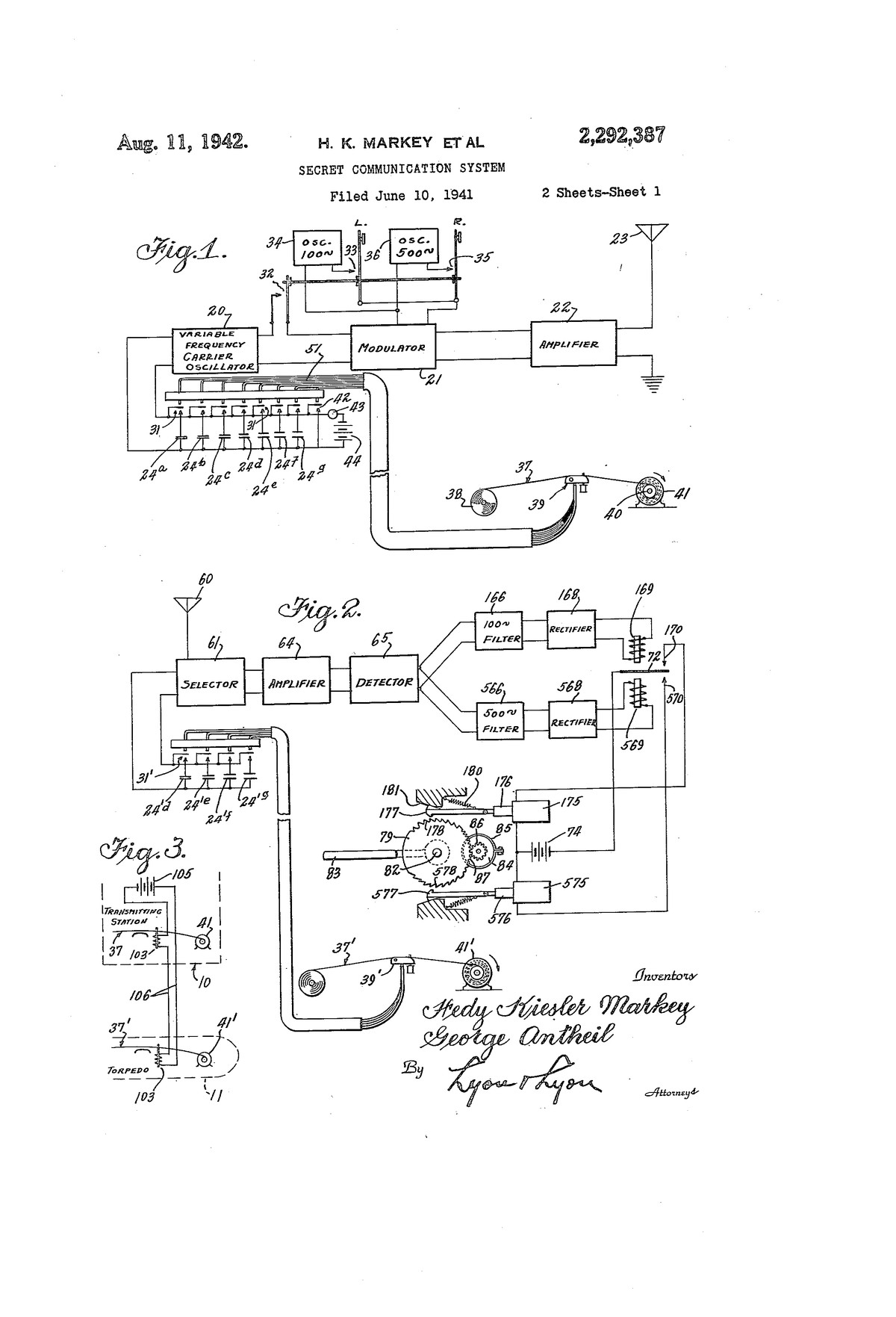 A drawing sheet from Lamarr and Antheil's 1942 U.S. Patent 2,292,387 for a "Secret Communication System." Image: U.S. Patent and Trademark Office, public domain, via Google Patents.
What this means for you
Frequency hopping is one branch of a bigger family called spread spectrum: spreading a signal so it is harder to jam, intercept or drown out. You do not need a torpedo to care. Modern Bluetooth devices hop across channels many times a second. Early Wi-Fi, under the first IEEE 802.11 rules ratified in 1997, offered a frequency-hopping mode that worked in the same basic spirit — short dwells on one frequency, then a jump — on the 2.4 GHz band. GPS cousins and plenty of remote-control gear lean on related ideas.
None of that means Lamarr "invented Wi-Fi." She and Antheil co-patented a jam-resistant radio scheme for guiding craft, built around synchronized hopping. Later engineers built electronic versions and put related methods into the wireless stack you use every day. The honest line is lineage, not a single eureka that skipped straight into your router.
If you work in coffee shops, airports or hotel lobbies, treat public Wi-Fi as shared air. A VPN on your phone or laptop encrypts your traffic on its way through the café network, so other people on that network have far less to see. That is a small, practical cousin of the same worry Lamarr had: other people on the channel. Our guide below walks through when a VPN helps and when it does not.
The Navy passed
Lamarr and Antheil offered the invention to the war effort. Navy reviewers declined to put it on torpedoes. In Antheil's later telling, the proposed gear looked too bulky for a torpedo, and the words "player piano" did not help. The image of stuffing a parlor instrument into a weapon was an easy joke, even if the real point was the paper-roll timing, not a full piano.
So Lamarr did the other wartime job Hollywood was good at. She sold war bonds. Under a stunt that offered a kiss for a $25,000 purchase, she moved about $7 million in bonds in a single night. Glamour sold. The patent sat.
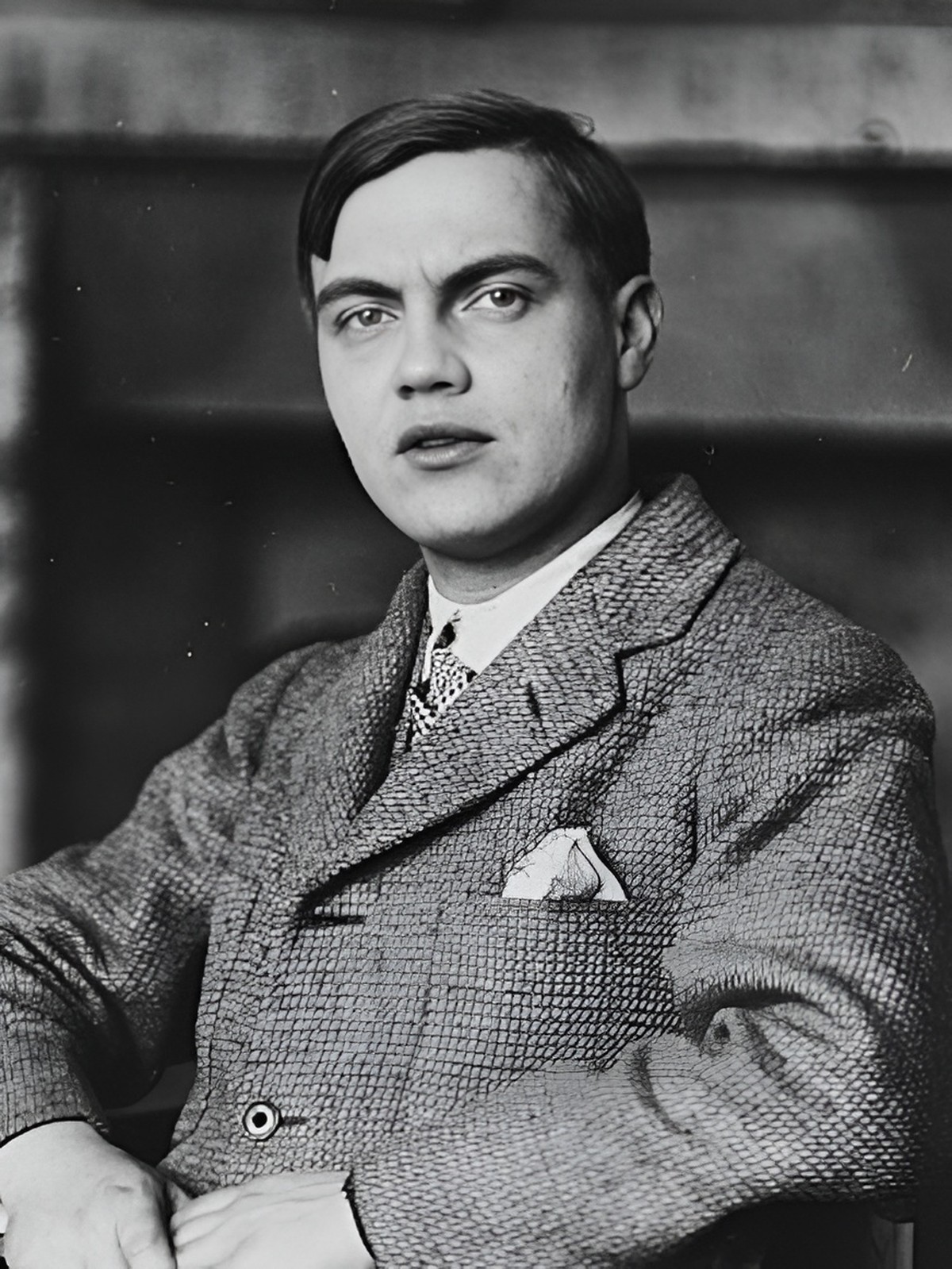 George Antheil in 1927. He co-patented the Secret Communication System with Hedy Lamarr and had already written music for synchronized player pianos. Photo: Berenice Abbott, public domain, via Wikimedia Commons.
Recognition arrived late
Engineers at Sylvania and elsewhere took a fresh look at frequency-hopping ideas in the 1950s, then built electronic versions instead of mechanical rolls. During the Cuban Missile Crisis naval blockade in 1962, U.S. forces put related electronic spread-spectrum methods to work. By then the Lamarr-Antheil patent had already expired, in 1959 — the same year Antheil died. They collected no royalties from it.
Commercial wireless kept climbing. Cell phones, Bluetooth, GPS-related systems and Wi-Fi all lean on spread-spectrum and hopping cousins in ways no 1942 paper roll predicted. One of the original IEEE 802.11 modes used frequency hopping on the 2.4 GHz band after the patent had long since lapsed.
In 1997, the Electronic Frontier Foundation gave Lamarr and Antheil a Pioneer Award for that early frequency-hopping work. The reply that stuck to the story was short: "It's about time."
The curveball I cannot shake is this. The patent that sketched 88 hopping channels like a piano score ran out unused by the Navy, three years before a crisis made related electronic methods look urgent, and decades before Bluetooth headsets and coffee-shop Wi-Fi made hopping ordinary. Lamarr raised millions selling bonds with a smile. The inventor's payday did not come. The idea did.
Today's cheat code: decide when a VPN is worth it on public Wi-Fi — Do You Need a VPN? A Plain Answer for 2026.
Enjoyed this? Follow Tech Cheat Codes on TikTok for quick tech tips: Follow on TikTok. Or open TikTok and search "Tech Cheat Codes".
References
- Source: U.S. Patent 2,292,387, Hedy Kiesler Markey and George Antheil, "Secret Communication System," filed June 10, 1941, granted Aug 11, 1942, via Google Patents (player-piano records, up to 88 frequencies, torpedo/remote craft control, synchronous rolls, false channels)
- Source: Smithsonian Magazine, Gilbert King, "Team Hollywood's Secret Weapons System," May 23, 2012 (patent 2292387; expired 1959; Navy found piano-like gear too cumbersome; war-bond kiss stunt, about $7 million in one night; Sylvania/electronic follow-ons; Cuban Missile Crisis blockade use of related spread-spectrum methods; no royalties; EFF Pioneer recognition; "It's about time")
- Source: Lemelson Center / Smithsonian Invention Story, "A Movie Star, Some Player Pianos, and Torpedoes" (1940 Hollywood meeting; Ballet mécanique and sync; National Inventors' Council; patent June 1941 / August 1942; Antheil on Navy "too bulky" and "player piano" reaction; patent expired 1959, Antheil died 1959; EFF Sixth Annual Pioneer Award 1997; "It's about time")
- Source: IEEE Standards Association, "Actress/Inventor Hedy Lamarr – and How Far Wireless Communication Has Come," June 23, 2023 (US 2,292,387A; jam-resistant torpedo guidance; patent expired 1959; original IEEE 802.11 FHSS mode; Bluetooth and related wireless lineage without calling her the sole inventor of Wi-Fi)
- Source: Electronic Frontier Foundation, "EFF Awards: Past Winners" (1997 winners include Hedy Lamarr)
- Source: Electronic Frontier Foundation, "12 Pioneering Women in Tech" (1997 special Pioneer recognition for Lamarr and Antheil frequency-hopping work linked to later wireless data systems)
- Source: MIT Lemelson Center inventor profile, "Hedy Lamarr" (player-piano-like slotted rolls; Navy originally rejected; 1997 EFF Pioneer Award; died 2000)