
On this page · 5 sections
Seventy-four years ago tonight, a room-sized computer in Philadelphia called a presidential landslide while America still thought the race was close. The network with the machine did not put that call on the air.
On Tuesday, Nov 4, 1952, CBS asked a UNIVAC — Universal Automatic Computer — to forecast Dwight D. Eisenhower against Adlai Stevenson from early returns. Polls had framed a tight race. UNIVAC's first serious look at the numbers did not. It saw Eisenhower sweeping. The people minding the machine flinched, softened what viewers heard, and only confessed after midnight that the computer had been right from the jump.
Today is Wednesday, Nov 4, 2026. That election night turns 74.
A fake console in New York, a real brain in Philly
In 1952, a big electronic computer was still a rare sight. Remington Rand had bought the Eckert-Mauchly team that built ENIAC, then pushed UNIVAC as a commercial machine with a name ordinary people could pronounce. Only a handful of large electronic computers existed in the whole country. CBS struck a deal to put one into election-night TV. For many viewers, this would be the first time they ever "met" a computer on a news desk instead of in a lab story.
The catch was size and nerves. The working UNIVAC stayed at Remington Rand's plant in Philadelphia. It was the fifth machine built, already lined up for later work at the Atomic Energy Commission's lab in Livermore, California. What sat in the CBS studio in Grand Central Terminal was a dummy control console — a stage prop with blinking lights — so Charles Collingwood could point at something while Walter Cronkite anchored the night. Vote totals came in over the wire services, got teletyped to Philadelphia, and got typed into the real machine there. Extra minutes vanished just moving numbers from Manhattan to the factory floor and into the program.
Memory lived in tubes of mercury that held electric pulses, plus magnetic tape that could hold far more than a stack of punched cards. Tape was the quiet revolution: the machine could reach its own data without waiting for another tray of cards. It multiplied hundreds of times a second. That sounds slow now. In 1952 it felt like science fiction wearing a business suit.
Collingwood tried to make the hardware feel friendly. Those round things that looked like candy mints were reels of metallic tape. When it was time for the big ask, he talked to the box like a guest on the set: "Have you got a prediction for us, UNIVAC?"
Dead air. Cronkite filled. Viewers had no idea the real answer was already forming a state away.
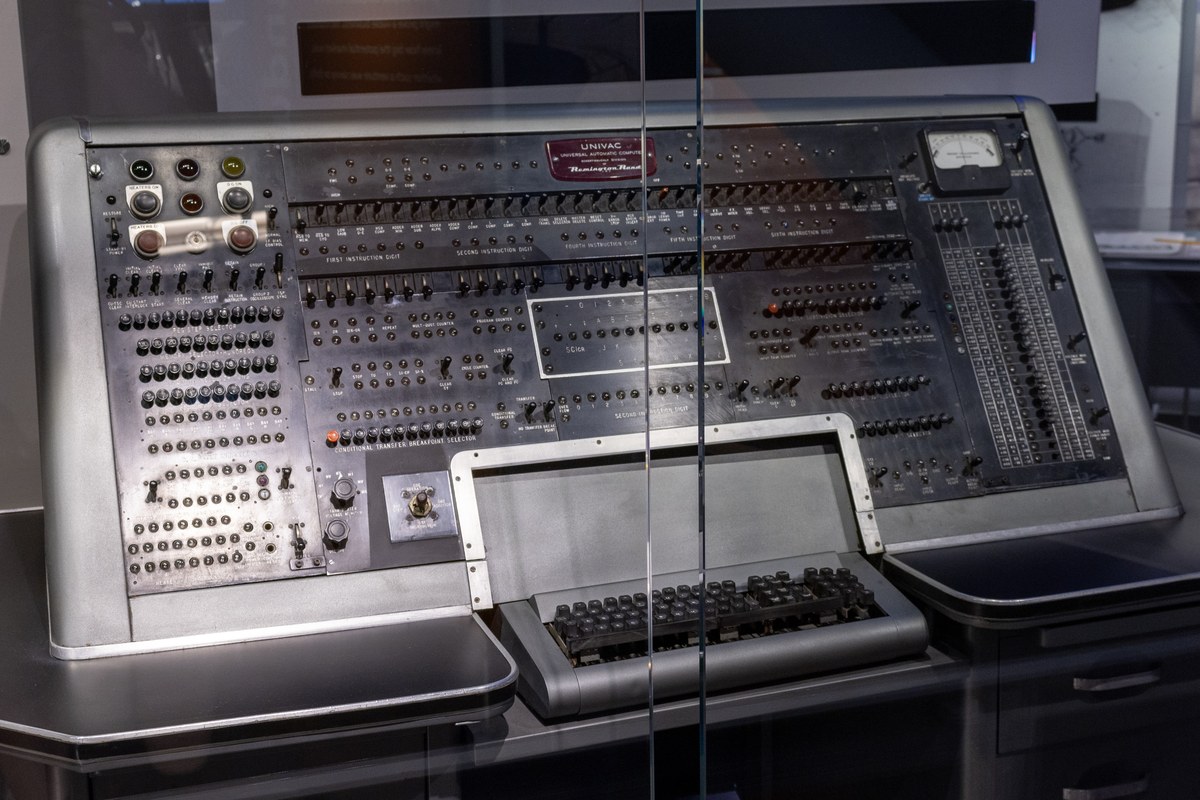 A UNIVAC I supervisory control console at the Computer History Museum in Mountain View, California — the kind of panel CBS put on camera while the working machine stayed in Philadelphia. Photo: The wub, CC BY-SA 4.0, via Wikimedia Commons.
The landslide nobody wanted to air
Pollsters had reasons to sound careful. Four years earlier, the industry's black eye was still fresh: newspapers and polling shops had been so sure Thomas Dewey would beat Harry Truman that a wrong headline became a museum piece, and nobody on a national desk wanted a replay. Going into 1952, many public forecasts still treated Eisenhower versus Stevenson as a close fight, even if Eisenhower held a slight edge in some polls, so a computer promising a blowout would sound reckless on live television.
UNIVAC's job was not magic. Programmers had built a statistical model from past elections. As early city and county returns arrived, the machine compared them with what those places had done before, then projected the gap onto places still voting. Feed it enough early numbers, and it could sketch a national finish before the map was filled in.
By around 9 p.m., after roughly three million votes had been fed in, the forecast was blunt: Eisenhower by a landslide, with odds around 100 to 1. The display had a small, almost comic flaw. Nobody had planned for three digits of odds, so "100 to 1" showed up truncated as "00 to 1." The programmers stared at a result that smashed the nail-biter script.
They did not trust it. Or they did not trust what would happen if they aired it. Either way, that early landslide call stayed off the broadcast. An on-air segment around 10:30 gave a softer split of states that sounded closer to what commentators already thought they were seeing. A later pass around 11:30 shrank Eisenhower's lead to a slim 270 to 261 in the Electoral College before the odds roared back to 100 to 1 for Eisenhower near 11:45. The human desk kept talking. The machine, off camera, had already picked a winner.
One more wrinkle: some early Massachusetts returns fed to the machine were wrong. The model still held. NBC and ABC also played with computing gadgets that night. UNIVAC was the one that stuck in jokes, ads and living-room memory, partly because Remington Rand leaned hard into the TV spotlight.
When the real country finished voting, Eisenhower had 442 electoral votes and about 33.8 million popular votes. Stevenson had 89 electoral votes and about 27.3 million. Landslide. After midnight, Remington Rand's Art Draper came on air with the rarest thing in live TV — a flat admission. They should have had the nerve to believe the machine in the first place. It was right. They were wrong. Next time, he promised, they would believe it.
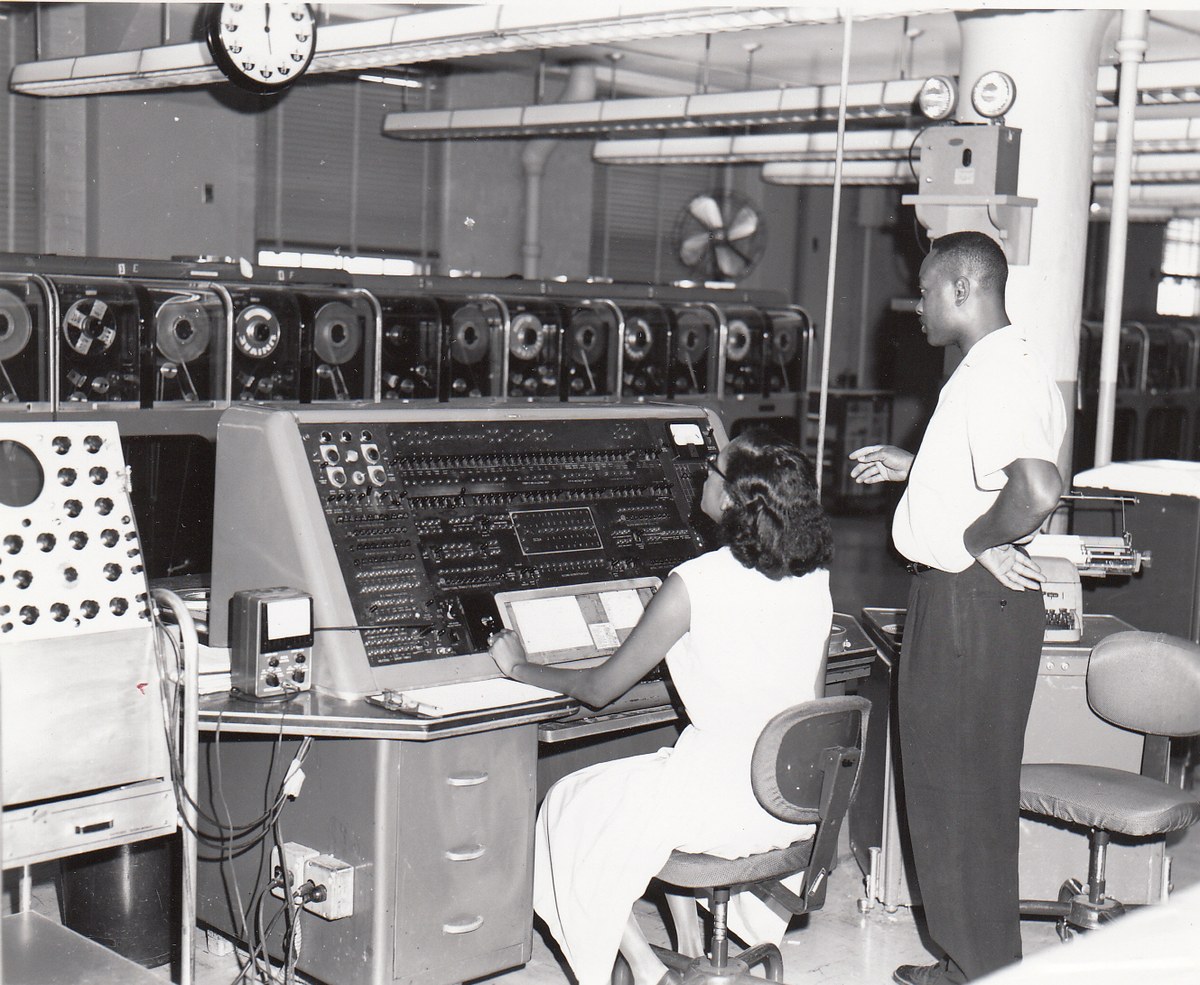 U.S. Census Bureau operators with a UNIVAC system in a period photograph — the same family of machines that crashed into living rooms on election night 1952. Photo: U.S. Census Bureau, public domain, via Wikimedia Commons.
What it means for you
That night was the soft launch of a habit we still live with: screens that tell you who is "winning" before every ballot is counted. The tools got smaller and faster. The tension did not. Humans still argue with models when the models spoil a preferred story. Networks still choose what to say out loud, and when. You do not need a room full of mercury memory to feel the modern version. Political texts, "go vote" nudges and last-minute fundraising pings keep hitting phones long after many people have already cast a ballot. Seniors and busy parents get the same pile as everyone else: another alert, another link, another claim that tonight decides everything. If those messages are still buzzing after you voted, you can shut off the political SMS drip on iPhone or Android without throwing away the texts you still want. The short walkthrough is linked below.
For the bigger picture, treat any early call — on TV, on a phone alert or in a group chat screenshot — as a forecast, not a final score, and wait for certified results from your state or county elections office when the question is your own race. Check the timestamp. Ask whether the number is a projection or a counted total. A model can be early and right, early and wrong, or early and quietly edited for an audience that expects a closer fight, and UNIVAC's first night on national TV managed all three moods before sunrise.
The Christmas-tree secret behind the blink
Here is the detail that still makes me laugh, then stop.
The console America watched in New York was hollow for the purpose that mattered. Its dramatic blink came from delay switches of the same kind people used to make Christmas-tree lights flash. The real UNIVAC that chewed the returns sat in Philadelphia, already ticketed for Livermore's nuclear lab once election night was over. A holiday blinker on camera. A classified booking offstage. And in between them, a forecast so lopsided the odds counter ran out of digits — a forecast humans sat on until the country proved the machine had seen the map first.
Today's cheat code: stop political "go vote" texts after you have already cast your ballot — Already Voted? How to Stop Political Texts.
Enjoyed this? Follow Tech Cheat Codes on TikTok for quick tech tips: Follow on TikTok. Or open TikTok and search "Tech Cheat Codes".
References
- Source: Computer History Museum, Alex Bochannek, "Have you got a prediction for us, UNIVAC?," Nov 7, 2012 (CBS election night Nov 4, 1952; dummy console in New York; real UNIVAC in Philadelphia destined for AEC Livermore; Collingwood candy-mint/tape line and "Have you got a prediction for us, UNIVAC?"; early correct Eisenhower landslide; 100-to-1 odds truncated as 00 to 1; final Eisenhower 442 / Stevenson 89 electoral, ~33.8M / ~27.3M popular; Art Draper after-midnight admission)
- Source: Computer History Museum Revolution, "UNIVAC Predicts an Eisenhower Win!" (Eckert and operator Harold Sweeney with Cronkite; polls favored close race / Stevenson narrative; 00 to 1 truncation of 100 to 1)
- Source: IEEE-USA InSight, Robert Colburn, "Your Engineering Heritage: Univac and the 1952 Presidential Election," Oct 1, 2012 (Chinoy timing notes; teletype path CBS to Philadelphia; programmers withheld early landslide as too risky vs polls; later softer on-air calls including near-tie then 100 to 1; wrong Massachusetts returns; UNIVAC-5; dummy console lights via Christmas-tree delay switches; mercury memory / tape context)
- Source: Smithsonian National Museum of American History, Grace Hopper Collection item, original UNIVAC Election '52 prediction printout text (early printout language with ~3.4M votes in and 100 to 1 for Eisenhower; Hopper ownership note)
- Source: Tech Cheat Codes, "Already Voted? How to Stop Political Texts" (iPhone and Android steps to quiet political SMS after voting)