On this page · 3 sections
If you drive a Chevrolet, Buick, GMC or Cadillac with OnStar, you may be wondering whether your braking, speed and trip times ended up in an insurance file. On Thursday, General Motors agreed to pay $220 million to settle claims from 36 attorneys general, from 35 states and the District of Columbia, that it sold that kind of driver data to data brokers, and that insurers then bought it from them.
GM did not admit wrongdoing. The consent decree states that GM does not admit any violation or liability, and that nothing in it counts as a concession. In an emailed statement, GM said: "This agreement addresses Smart Driver, a product we ended in 2024, and reinforces steps we’ve taken to strengthen our privacy practices."
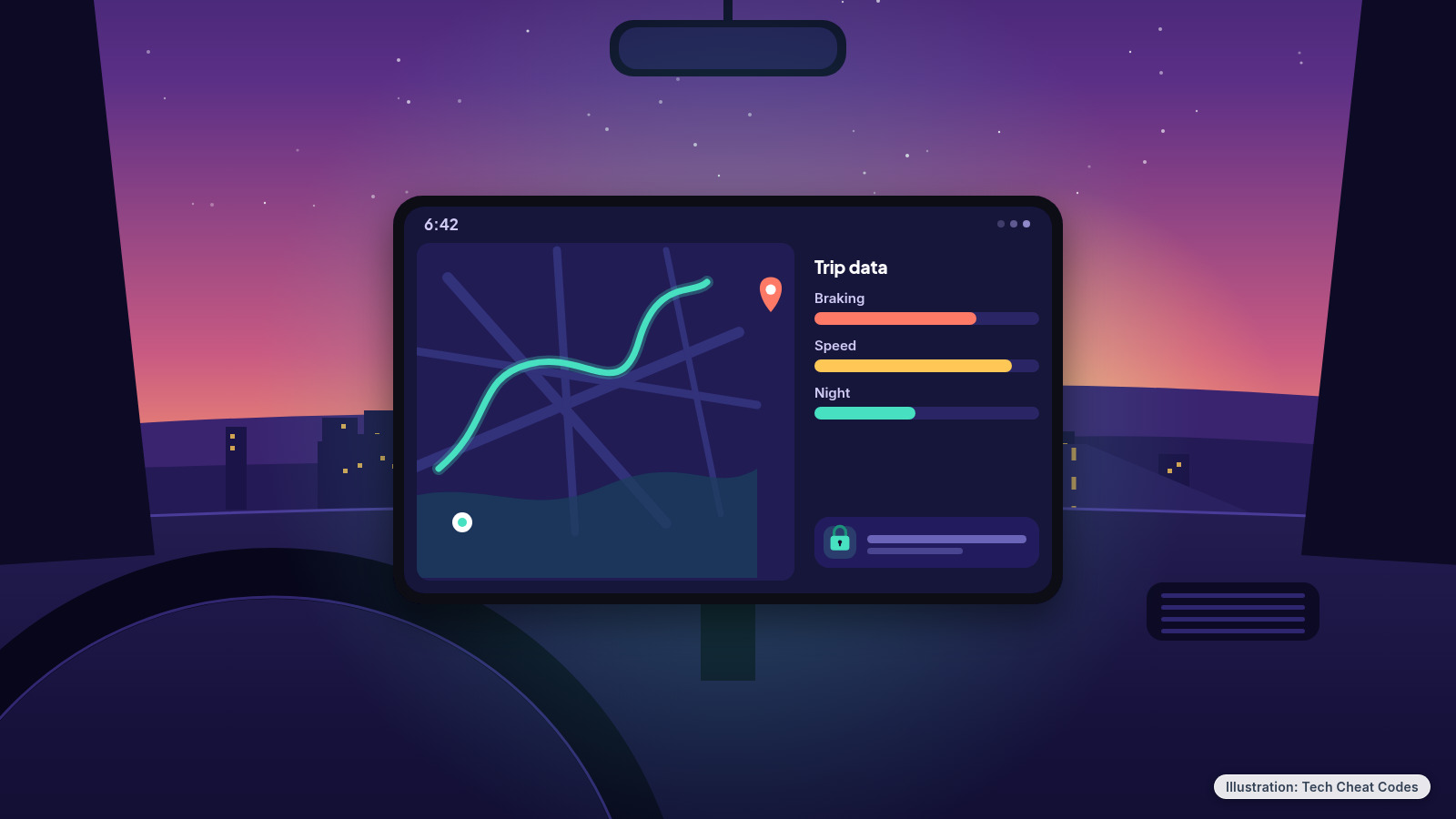
The case is about Smart Driver, an OnStar feature that GM pitched as a way to drive more safely. The states' complaint alleges GM collected hard braking, hard acceleration, hard cornering, high speeds, late-night driving, seat belt use and trip time, plus precise location tied to names, addresses and vehicle identification numbers. It alleges GM sold Smart Driver data to Verisk Analytics starting in 2015 and to LexisNexis Risk Solutions from 2019, that both turned it into reports and driver ratings for insurers, and that some insurers used that information in part to set rates. The complaint also alleges GM sold data for every Smart Driver customer, including people who did not join a separate insurance discount program.
What this means for you
You don't need to file anything. The $220 million goes to the states, and Washington's share is $12,311,819. The Washington decree sets up no claim form and no payments to drivers, and the state announcements don't mention either. Treat any message that offers to help you claim a share as suspect until an attorney general's own site backs it up.
What you get is more control, starting on the decree's effective date of Nov. 30, 2026. From then on, GM must get a driver's express consent before it collects or uses driving or location data, or hands it to an outside company. The exceptions include sending data to emergency responders, safety recalls, warranty work and legal requests. GM must let drivers turn off location collection on vehicles that support it, and unenrolling from OnStar must switch off GM's remote data collection. Dealership staff must be trained so buyers review the privacy terms and accept them themselves before they are enrolled.
The decree also covers old data. GM must ask the companies it gave data to before Jan. 16, 2025 to delete it, delete its own copies from before that date within 180 days of the effective date unless a driver agrees to let it keep them or a limited exception applies, and give drivers a way to ask for a copy of their data and for deletion. Several of these duties run until Jan. 13, 2046.
One caveat. We read Washington's decree, which defines a covered driver as a person in Washington. The other 35 are described as similar judgments, so the details in your state may differ. Texas is not on the list and sued GM on its own in August 2024. California reached its own $12.75 million deal with GM in May.
The FTC has its own order against GM and OnStar, announced as a proposed deal in January 2025 and finalized in January 2026. It bans GM from giving driver data to consumer reporting agencies for five years, and for 20 years it requires GM to offer every US consumer a way to ask for a copy of their data and for deletion.
What to do next
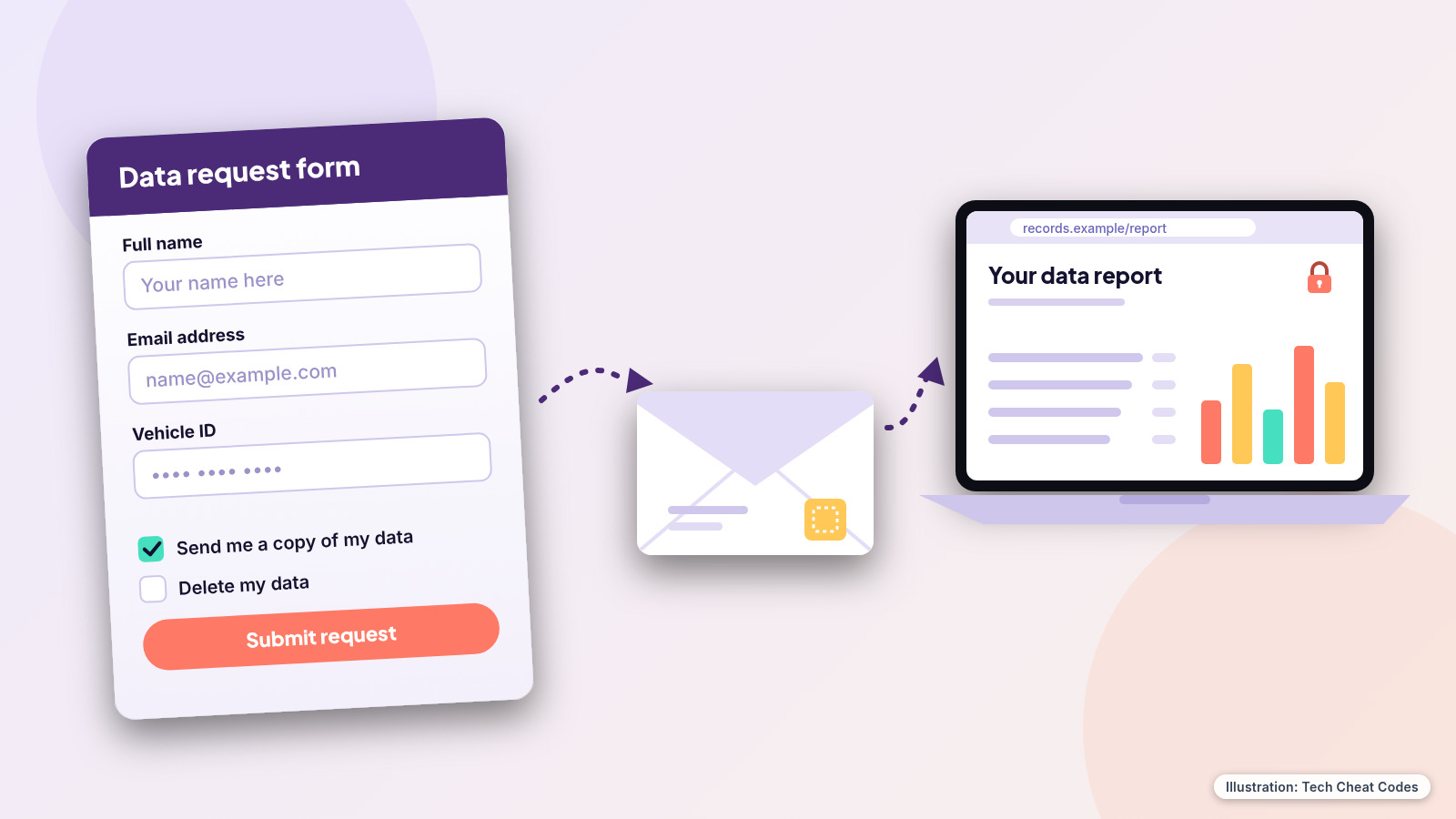
Start with what GM holds. Send GM's U.S. Consumer Privacy Request Form an access request, or call 1-866-697-7482. GM does not take these by email and can take up to 45 days. It will also list the vehicles it ties to you and the kinds of data it collected, which can include driving behavior and location. That tells you what exists before you decide what to switch off.
Then check with the two companies named in the complaint, Verisk and LexisNexis. The settlement papers we read don't name them.
Asking a data company for your file. Illustration: Tech Cheat Codes
| What the complaint describes | Where to check |
|---|---|
| Hard braking, hard acceleration, hard cornering, high speeds, late-night driving, seat belt use, trip time | Verisk, LexisNexis, and your GM request |
| Precise location tied to your name, address and vehicle number (the complaint alleges Verisk's contract barred it and that LexisNexis received it) | LexisNexis and your GM request |
For Verisk, fill out the Driving Behavior Data History Report form on its page, then email it to FCRA-NPC@verisk.com, fax it to 800-955-2422, or mail it to Verisk Underwriting Solutions Consumer Inquiry Center, P.O. Box 5404, Mt. Laurel, NJ 08054. Verisk gives one free report in any 12-month period, and its report covers GM data up to Mar. 18, 2024. For LexisNexis, use the online request form, call 1-866-897-8126, or mail its printable form to the LexisNexis Risk Solutions Consumer Center, P.O. Box 105108, Atlanta, GA 30348-5108. It may ask for your Social Security number or driver's license number to confirm who you are, and it mails you a letter with instructions to open the report online. The LexisNexis page doesn't say whether driving data appears in the Consumer Disclosure Report, so scan yours for trip entries.
If an insurer raised your rate or turned you down, look at the letter for the name of a reporting company. Verisk lists 1-800-709-8842 for a copy of a report tied to a notice like that.
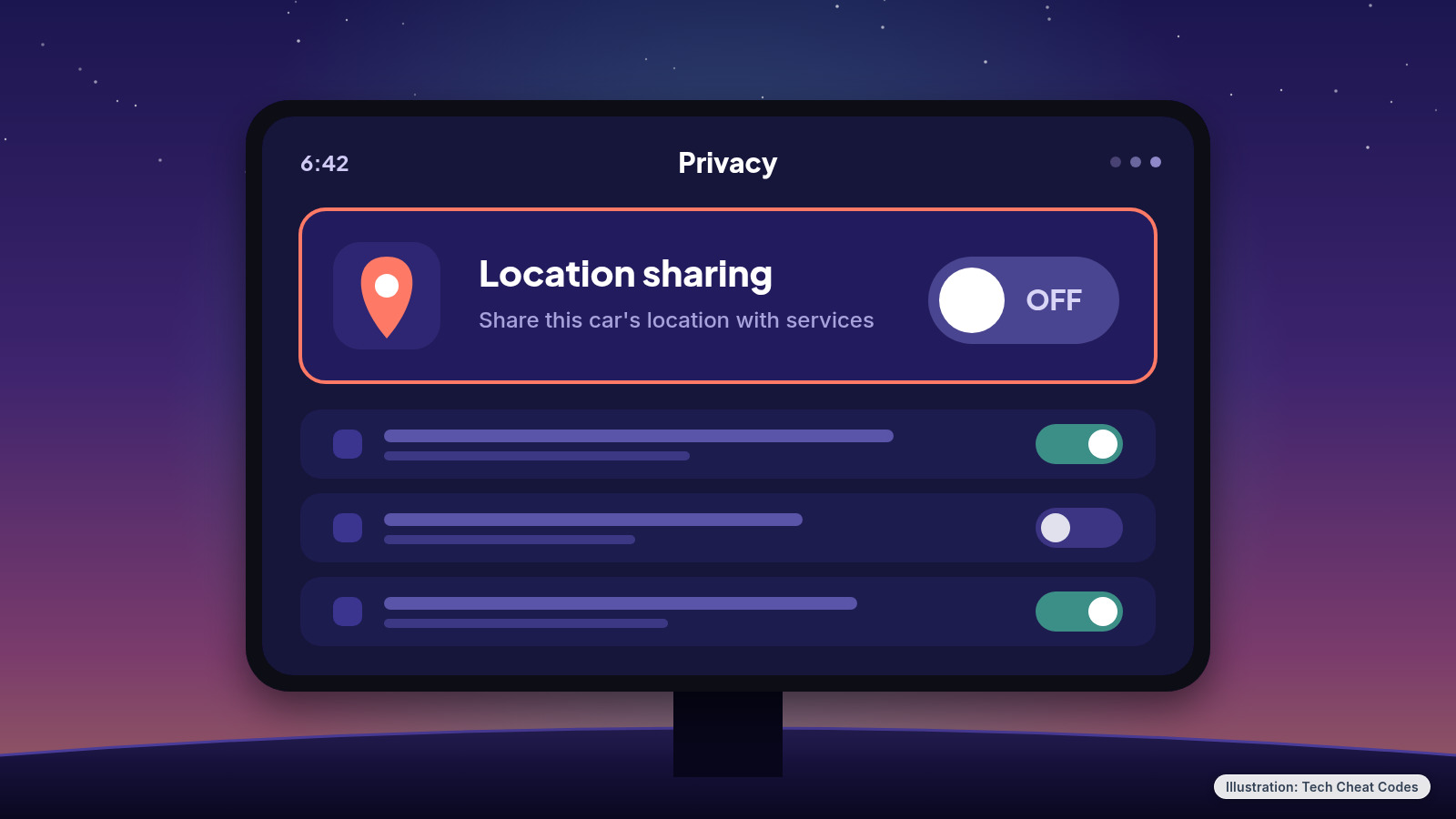
Next, limit what your car shares. In the vehicle, open Privacy Settings on the infotainment screen. Some model year 2019 and later vehicles have an option there to turn off OnStar location services, though GM can still locate the vehicle in an emergency such as a crash. We found no published menu path for the myChevrolet, myBuick, myGMC or myCadillac apps, so use the car's screen and your owner's manual for exact menu names. In your GM account, GM points to a Data and Privacy section. We couldn't open that page without signing in, and GM's pages describe it for exterior camera consent, so check what else it offers once you're in.
A location switch on a car screen. Illustration: Tech Cheat Codes
To cut the connection entirely, call OnStar at 1-888-466-7827 or press the blue button in the car. Unenrolling removes the vehicle from all connected services, so decide first whether you can do without OnStar's crash response and navigation. GM may still collect location when you press the blue button, and on electric vehicles if the high-voltage battery overheats.
Send the GM access request first, since it shows you what to ask for at Verisk and LexisNexis.
References
All 19 reference links
- Source: Washington Attorney General, GM to pay $220M for sharing drivers' private data
- Source: Washington consent decree, State of Washington v. General Motors LLC (PDF)
- Source: Washington complaint, State of Washington v. General Motors LLC (PDF)
- Source: Oregon Department of Justice, AG Rayfield leads states in $220M settlement with GM
- Source: New York Attorney General, Attorney General James secures $220 million from General Motors
- Source: Maryland Attorney General, $220M multistate settlement with General Motors
- Source: The Verge, GM to pay $220 million to resolve claims it sold driving habits data
- Source: TechCrunch, GM reaches $220M settlement over selling drivers' private data
- Source: Reuters (via Investing.com), GM to pay $220 million to settle allegations it violated drivers' privacy
- Source: California Attorney General, Attorney General Bonta, partners secure $12.75 million General Motors privacy settlement
- Source: Texas Attorney General, Attorney General Paxton sues General Motors, Aug. 13, 2024
- Source: FTC, Final Decision and Order, General Motors LLC (PDF)
- Source: GM, U.S. Consumer Privacy Statement
- Source: GM, Privacy Center
- Source: GM, U.S. Consumer Privacy Request Form
- Source: GM, Data and Privacy section of your GM account (sign-in required)
- Source: LexisNexis Risk Solutions, Consumer Disclosure Report
- Source: LexisNexis Risk Solutions, Order your report online
- Source: Verisk, Driving Behavior Data History Report and consumer requests
Never miss a cheat code
Get plain-English tech fixes and scam alerts: follow on TikTok, YouTube or Instagram.
Related fixes
How to Turn On Two-Step Verification for Google, Apple, Microsoft, Facebook, Instagram and Amazon
Add a second sign-in step to Google, Apple, Microsoft, Facebook, Instagram and Amazon: pick an app, text code or passkey, then save your backup codes.
Accounts & Security · 11 min read
Is This a Scam? 4 Warning Signs and What to Do Next, for Parents, Kids and Grandparents
Is this a scam? Learn the FTC's 4 warning signs, spot the tricks aimed at kids, teens and grandparents, and know exactly who to call if you already paid.
Scams · 6 min read
Phone Battery Draining Fast? Free Fixes for iPhone and Android
Phone battery dying by lunch? Find what's draining it and fix it free on iPhone, Pixel or Samsung Galaxy before you pay for a new battery or phone.
Phones & Storage · 5 min read