
On this page · 3 sections
What happened: Open Enrollment for 2027 health plans on the Health Insurance Marketplace started Sunday, Nov. 1, and runs through Jan. 15. For nearly 11 weeks, real plan ads and fake ones will be competing for the same spot in your feed, your inbox and your voicemail.
What this means for you: If you buy your own coverage, or help a parent or an employee do it, sign up only through HealthCare.gov or a helper it lists. Nobody gets to charge you to apply or to keep your coverage. Anyone who asks for a gift card, a credit card number or crypto to "hold your spot" is running a scam.
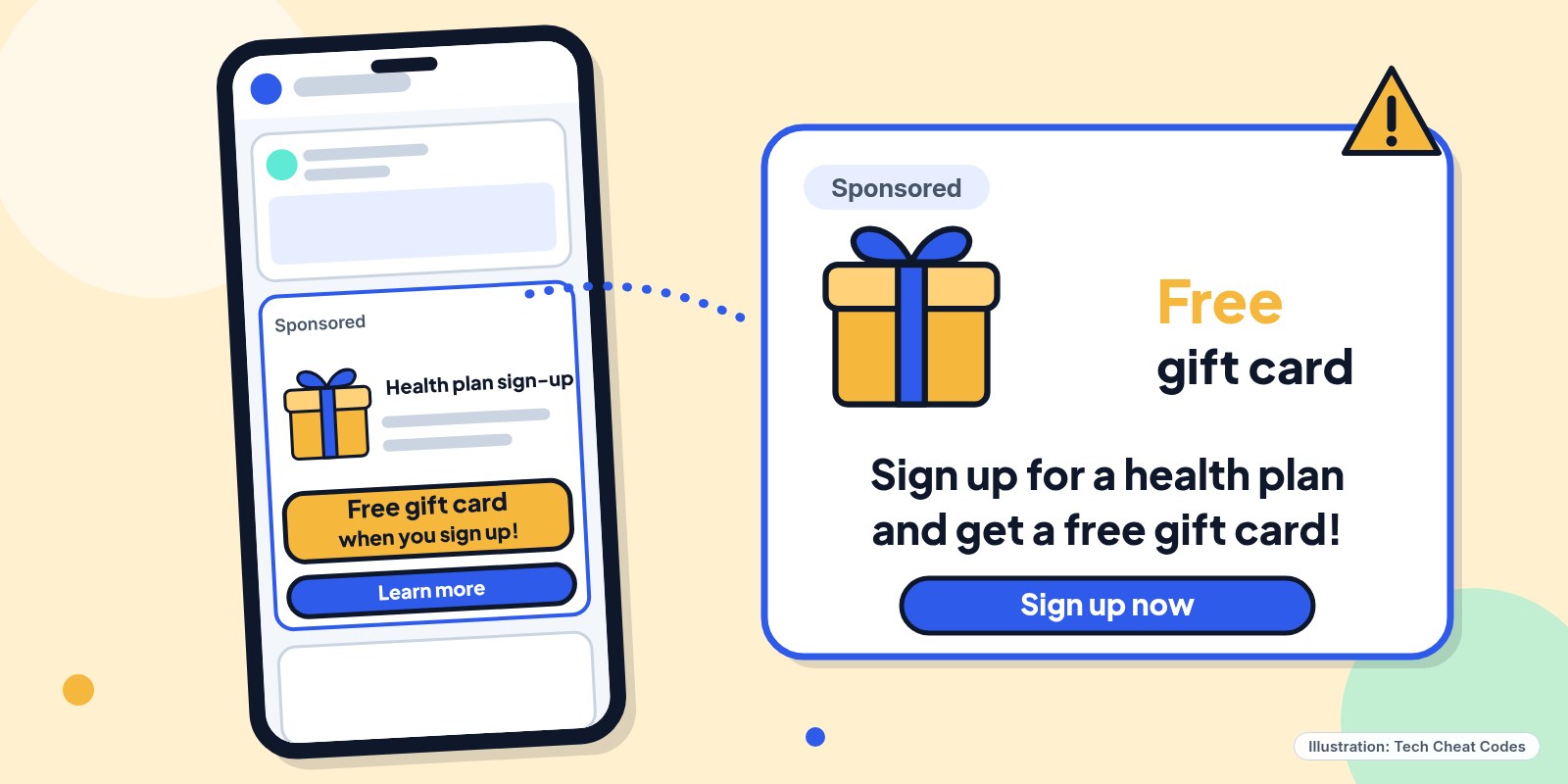 Ads that offer cash or gifts for your information are a red flag. Illustration: Tech Cheat Codes
The first week of enrollment is when the pitches get loudest. A post in your feed promises a $0 plan and a gift card if you "just confirm your details." A text claims your coverage will lapse unless you pay today. Someone knocks on the door with a clipboard and a badge, saying they're from the Marketplace.
The Marketplace doesn't work that way. It doesn't threaten anyone in your household, and it doesn't ask for your credit card or any payment to apply for coverage or keep it. Your monthly premium goes straight to the insurance plan you pick, not to a caller, an agent or a website in between.
The details
Open Enrollment is the one window each year when anyone can sign up, renew or switch Marketplace plans without a special reason. The dates matter, because the day you enroll decides the day your coverage starts.
| Date | What it means |
|---|---|
| Nov. 1, 2026 | Open Enrollment opened for 2027 coverage |
| Dec. 15, 2026 | Last day to enroll or change plans for coverage that starts Jan. 1 |
| Jan. 1, 2027 | Coverage starts if you enrolled by Dec. 15 and paid your first premium |
| Jan. 15, 2027 | Open Enrollment ends |
| Feb. 1, 2027 | Coverage starts if you enrolled Dec. 16 through Jan. 15 and paid your first premium |
After Jan. 15, you can only sign up or switch if you qualify for a Special Enrollment Period because of a life change, like moving, losing other coverage, getting married or having a baby. Medicaid and the Children's Health Insurance Program (CHIP) take applications any time of year.
That long window is exactly what scammers count on. They don't need you to buy a fake plan. Most of the time they want your Social Security number, your bank details or your medical history, which can be used without your consent long after the call ends.
The warning signs on HealthCare.gov's fraud page are blunt. Watch for health insurance ads on social media that offer cash, gifts or other perks. Watch for anyone who emails, texts or shows up at your home uninvited and claims to be from the Marketplace. And treat any request to pay with a gift card, cash, a prepaid debit card or cryptocurrency as the scam it is.
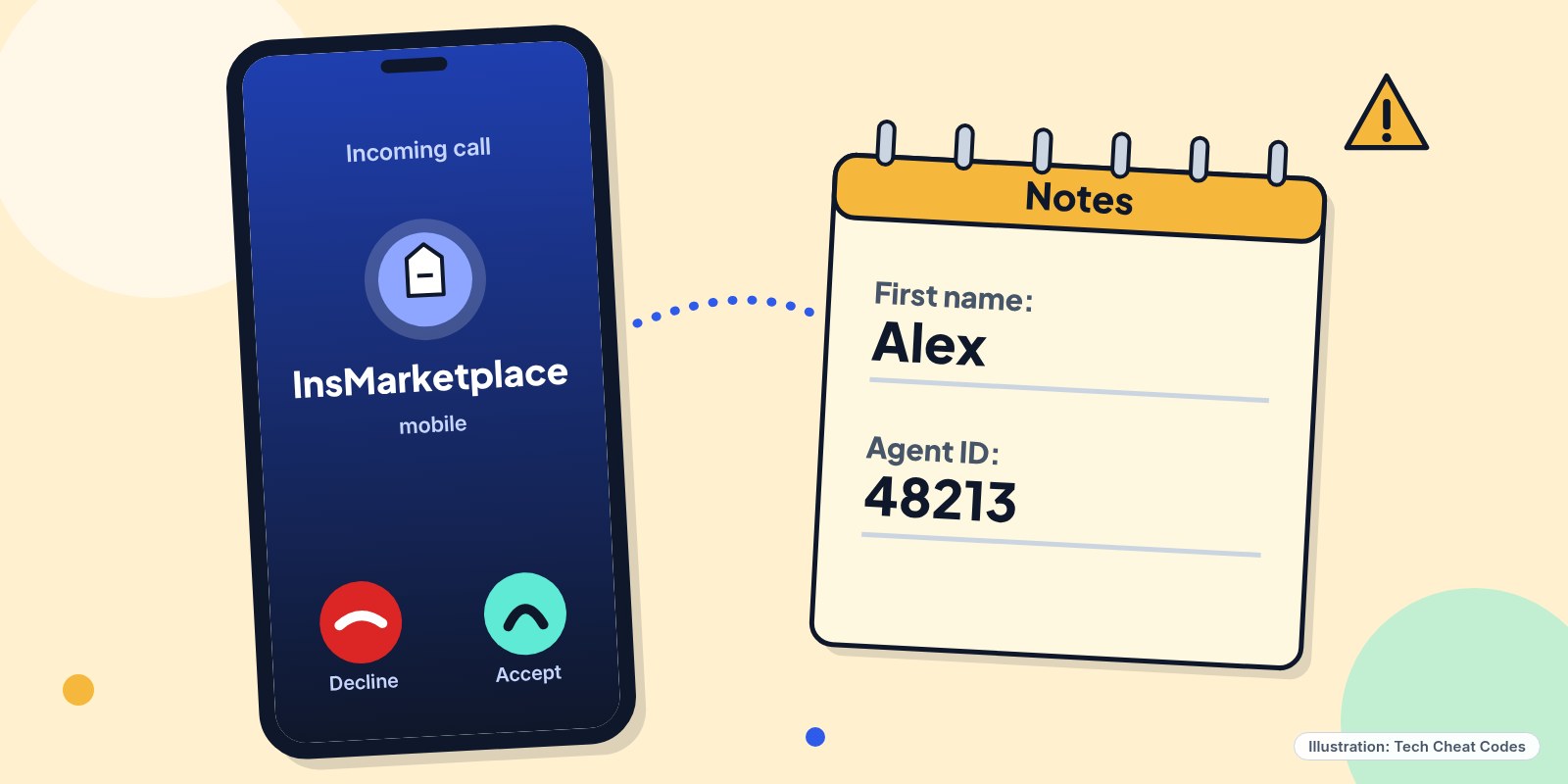 A real Marketplace caller gives a first name and an agent ID. Write both down. Illustration: Tech Cheat Codes
What a real Marketplace call looks like
Sometimes the Marketplace really does call, usually to confirm something on your application. Those calls come from 1-855-997-1890 or 844-477-7500, with a caller ID of "Health Insurance MP" or "InsMarketplace." The caller introduces themselves as being with the Marketplace and gives a first name and an agent ID number. If you don't pick up, they may leave a voicemail. After three tries, you get a letter instead.
A real caller may ask for your application ID, birth date, Social Security number, contact information and details about your household and job. A real caller won't ask for a bank or account number, your health history or anything about your Marketplace account login. That line is the easiest one to remember.
You're also allowed to stop the call. If something feels off, or you simply don't want to share anything over the phone, hang up and call the Marketplace Call Center yourself at 1-800-318-2596 (TTY: 1-855-889-4325), or ask them to mail you a letter. The call center is open 24 hours a day, seven days a week, except holidays.
Did you know? The Marketplace has two-step login codes for your HealthCare.gov account. The real ones come by text or phone call from 1-877-320-6986, or by email from accounts@healthcare.gov. If a "code" shows up from anywhere else, don't trust it.
Agents, brokers and free helpers
You don't have to do this alone, and the real help is free to you. There are three ways to get it. You can call the Marketplace Call Center, where you can ask questions, start or finish an application, compare plans or enroll, in English and other languages. You can meet with a trained assister in your area, people sometimes called "navigators," using the search at localhelp.healthcare.gov. Or you can work with a licensed agent or broker.
Agents and brokers may be paid a commission by the insurance company when they enroll you in a plan, so you shouldn't be handed a bill for their help. If someone contacts you first, write down their name, who they work for, their phone number, street and mailing address, email and website. Don't share personal information until they give you a Privacy Notice Statement and you've read it and agreed to it.
HealthCare.gov also keeps a list of partner websites approved to give you quotes and help you enroll. A slick site that isn't on that list, especially one you reached through a paid ad, isn't one of them.
For small-business owners
If you run a small company and want to offer coverage to your employees, the Small Business Health Options Program (SHOP) has its own help line, at 1-800-706-7893 (TTY: 1-888-201-6445). The same rules apply to anyone who calls your business claiming to be from it.
What to do now
If you're shopping for 2027 coverage, or helping someone who is, these are the steps that matter.
- Start at HealthCare.gov by typing the address yourself. Check that any government site ends in ".gov."
- Mark Dec. 15 on your calendar if you want coverage on Jan. 1, and Jan. 15 as the last day for 2027.
- Turn on login security codes for your HealthCare.gov account.
- When someone calls about your coverage, compare the number and caller ID with the ones above, and write down the caller's first name and agent ID.
- Pay your premium only to the insurance company you chose.
- If you already gave out a bank number or your Social Security number to someone suspicious, call the Marketplace Call Center, report it to the Federal Trade Commission at ReportFraud.ftc.gov, and contact your local police department.
If an older parent gets most of their news from Facebook, this is a good week to sit with them and scroll past one of these ads together. The "free gift card for your details" pitch looks a lot less tempting once someone has pointed it out.
The next date on the calendar is Dec. 15, the cutoff for a Jan. 1 start.
References
Get the next cheat code
Plain-English tech fixes and scam alerts. Tap Follow on Facebook or TikTok, or pick another below.
Related fixes
How to Turn On Two-Step Verification for Google, Apple, Microsoft, Facebook, Instagram and Amazon
Add a second sign-in step to Google, Apple, Microsoft, Facebook, Instagram and Amazon: pick an app, text code or passkey, then save your backup codes.
Accounts & Security · 11 min read
Is This a Scam? 4 Warning Signs and What to Do Next, for Parents, Kids and Grandparents
Is this a scam? Learn the FTC's 4 warning signs, spot the tricks aimed at kids, teens and grandparents, and know exactly who to call if you already paid.
Scams · 6 min read
Phone Battery Draining Fast? Free Fixes for iPhone and Android
Phone battery dying by lunch? Find what's draining it and fix it free on iPhone, Pixel or Samsung Galaxy before you pay for a new battery or phone.
Phones & Storage · 5 min read